Now is the right time to become an American Federation of Musicians member. From ragtime to rap, from the early phonograph to today's digital recordings, the AFM has been there for its members. And now there are more benefits available to AFM members than ever before, including a multi-million dollar pension fund, excellent contract protection, instrument and travelers insurance, work referral programs and access to licensed booking agents to keep you working.

As an AFM member, you are part of a membership of more than 80,000 musicians. Experience has proven that collective activity on behalf of individuals with similar interests is the most effective way to achieve a goal. The AFM can negotiate agreements and administer contracts, procure valuable benefits and achieve legislative goals. A single musician has no such power.

The AFM has a proud history of managing change rather than being victimized by it. We find strength in adversity, and when the going gets tough, we get creative - all on your behalf.

Like the industry, the AFM is also changing and evolving, and its policies and programs will move in new directions dictated by its members. As a member, you will determine these directions through your interest and involvement. Your membership card will be your key to participation in governing your union, keeping it responsive to your needs and enabling it to serve you better. To become a member now, visit www.afm.org/join.

FIND OUT MORE ABOUT THE AFM


Home » On the Cover » Dayton Philharmonic Musicians Unite to Fight Devastating Management Cuts


Dayton Philharmonic Musicians Unite to Fight Devastating Management Cuts

  -  

How the determined DPO players committee is leveraging resources, local solidarity, and public outreach to stand up to bad-faith management.

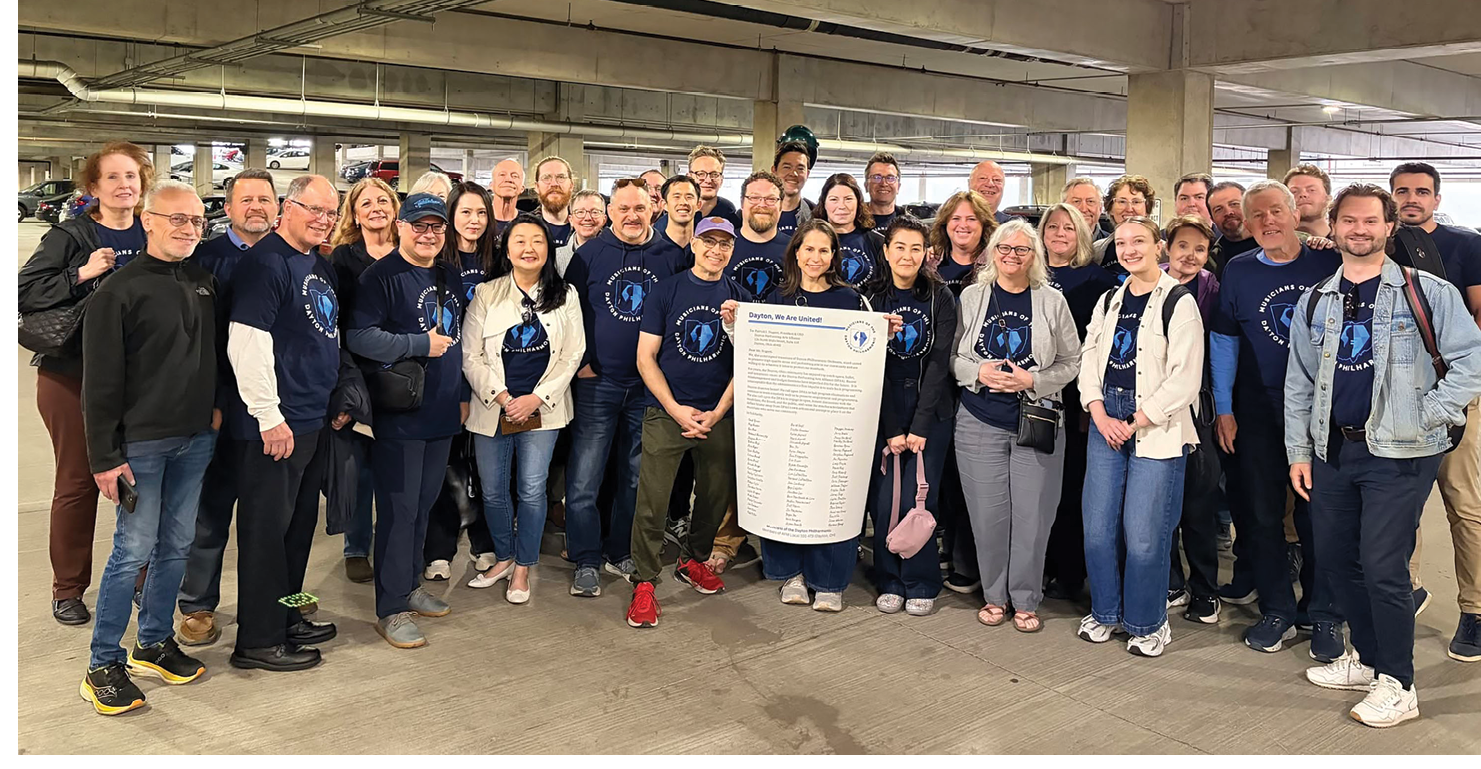
Musicians of the Dayton Philharmonic Players Committee (front): Chad Arnow, Local 101-473 President/Secretary-Treasurer Kweku Ayangade, Jonathan Lee; (back): John Kurokawa, Amy Lassiter, Rachael Young, Kara Camfield.

It’s an unfortunate reality that orchestra boards and managements typically never learn from a repeatedly proven lesson: they can’t cut their way to financial health. The industry is filled with examples of orchestras over past decades that had drastic reductions thrust upon them in misguided attempts to balance the organization’s budget. Many of these orchestras are still recovering. And of course, it’s the musicians themselves who bear the brunt of these cuts—but also, they are often the ones who take on the responsibility of trying to “fix” things.

This same playbook is currently repeating itself in Dayton, Ohio, where the Dayton Philharmonic Orchestra (DPO) is dealing with an intractable board and management that has proposed steep cuts in personnel, pay, and programming. The DPO’s players committee, all members of Local 101-473 (Dayton, OH), are working hard to counteract the orchestra’s disastrous moves before things go past the point of no repair.

View from the Players Committee

Briefly, a players committee (PC), also called an orchestra committee, is a small group of musicians (typically five or six) elected by their colleagues to represent them in dealings with the orchestra’s board and management. Their responsibilities can vary from negotiating and interpreting contracts to overseeing the daily affairs of the orchestra, ensuring that the musicians’ interests are represented.

Sometimes, as is the case in the DPO, the PC can also be called upon to be a first line of defense against bad faith bargaining by management. DPO bass trombonist Chad Arnow, current PC chair, says the DPO’s troubles fall at the feet of its current CEO, Patrick Nugent. But first, says Arnow, it’s important to understand the unique structure of the DPO as part of a larger organization.

“The Dayton Performing Arts Alliance (DPAA) was formed in 2012 to unite the Dayton Philharmonic, Dayton Opera, and Dayton Ballet as a single 501(c)(3) organization,” says Arnow. “The immediate goal was to preserve these three organizations, which had been hard hit by the 2008 recession, and promote artistic collaboration.” 

Nugent’s predecessor, explains Arnow, used a combination of government funding, savvy cash management, and far fewer performances during and just after the COVID-19 pandemic to pay off the organization’s accumulated debts and deficit. “The season after the pandemic, we agreed to orchestral service guarantees that were 50% of pre-COVID numbers,” he continues. “The subsequent three seasons had guarantees at 75%, followed by two seasons that were 10 more than the 75%, or 119 orchestral services for the top bracket.”

And then, enter Nugent, who took over as CEO in 2021. “He was handed, arguably, the healthiest version of the DPAA that ever existed,” says Arnow. The orchestra was in the midst of negotiations for a new contract, and the PC was invited to receive the DPAA’s counteroffer to their contract proposal at a January 31 DPAA board meeting. “Average musician pay in the 2025-26 season had finally reached pre-COVID numbers. Our proposal called for reasonable growth in wages and service guarantees,” he explains.

Demanding Action: Members of the Dayton Philharmonic Orchestra delivered an internal petition to DPAA President and CEO Patrick Nugent as part of a “march on the boss” action.

Blindsided by Reductions

Amy Lassiter, DPO horn player and PC secretary-treasurer, says things came to a head at that meeting. “DPAA notified us that our entire Pops and Rock series would be eliminated after this season because they were underperforming,” she says. “They also announced that our Masterworks series would be cut from two performances to one. This was followed within minutes by a press release announcing the cuts.” Needless to say, adds Lassiter, DPO musicians were shocked. “They told us this barely two hours before a difficult Masterworks concert. Somehow, we still managed to perform a magnificent concert that night.”

And the planned cuts don’t stop there. “Management also proposed massive service cuts so that the top tier of orchestral services would be only 70,” says Lassiter. “This represents a 40-50% cut in services and pay for most musicians.”

Arnow says management informed the PC at a negotiating meeting that it was trying to trim $1 million in expenses from the DPO’s budget. “Their numbers would result in a proposed 45% reduction in spending on the orchestra. It seems that the $1 million would come almost entirely out of cuts to musician wages and associated costs of killing the two concert series. This amounts to $635,000 directly coming out of DPO musicians’ pockets.”

Building Solidarity

Right after the negotiations, the musicians—led by the PC—took action. Arnow says the PC reached out to AFM Symphonic Services Division (SSD) negotiator Jane Owen, with whom the orchestra has worked for years in contract negotiations. “Jane immediately recommended we start working with AFM organizers. We had our first meeting with them less than three weeks after management’s bombshell proposal.”

“Things moved pretty quickly,” says Lassiter, “because we already had our negotiator from the AFM on board and we were quickly assigned a team from the AFM for communications, press, and organizing.”

DPO principal bassoonist and PC member Rachael Young believes the support and resources they’ve received from the AFM have been crucial. “We’ve had weekly meetings that have been vital for organizing, strategizing, and even helping us navigate the emotional side of this struggle.” Young says the DPO musicians have also benefited from public expressions of support by other local labor organizations, as well as delegates to the AFM Convention. “The strong sense of solidarity has been very encouraging.”

Young says the ballet dancers under the DPAA umbrella, newly unionized through the American Guild of Musical Artists (AGMA), offered their full support. “They are going through their own contract negotiations after organizing just last year, and they have shown up for many of our public events. They share the same frustrations with the failures of current leadership that led to this inflection point, and it’s been really helpful to know we’re in this together.” 

Lassiter adds that Dayton members of the International Alliance of Theatrical Stage Employees (IATSE) have also shown up for the musicians. “Our wonderful stagehands always support us,” she says. One of the PC members also attended a meeting hosted by the AFL-CIO that included other unions, which delivered moral support.

Taking It to the Streets

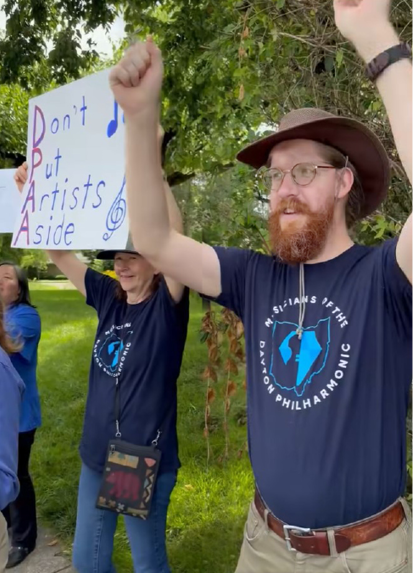
Leslie Stratton and Tyler Bentley, Dayton Philharmonic musicians, take to the street with signs on June 18 to oppose severe programming reductions.

Among the PC’s first concrete actions, two petitions were circulated, one to the musicians and the other to the public. Arnow says 100% of the musicians signed the petition, which was presented to Nugent at a “march on the boss” on May 14. The public petition, Protect the Arts in Dayton, has so far garnered over 2,100 signatures.

Signage and distributing leaflets and buttons to concertgoers in the lobby before DPO concerts has also helped raise public awareness and sympathy, according to Young.

But, she says, management is actively working to undermine our narrative. “We’ve heard some audience members and donors parrot false talking points, which we know management is spreading via emails sent to donors explicitly mischaracterizing our position on many issues.”

Arnow says it’s clear that DPO audiences are not happy with the direction management is taking the organization. “We recently also added a QR code to the leaflets enabling the public to send a predrafted letter directly to our board chair asking for positive changes,” he says. That letter campaign has gathered more than 450 submissions.

Young agrees that most of the DPO’s audience has been extremely supportive. “They are as angry as we are about the proposed cuts, and they can easily see the same marketing failures that we feel have hampered ticket sales in recent years. It’s clear they’re grateful for the chance to talk to us directly and express solidarity.” 

“Many patrons have expressed to me that they feel the next season has nothing to offer them,” adds Lassiter. “Some patrons are angry enough that they’ve written letters to the editor and offered to leaflet for us at their private events.” So far, says Lassiter, musicians have heard no feedback from the board regarding any of the public pressure being exerted.

A Resounding Vote of No Confidence

The musicians held a rally with more than 100 people in attendance right before a board meeting on June 18. They had planned to deliver the results of their 100% vote of no confidence and public petition at the meeting. But they were denied a chance to speak because they were not on the agenda, according to Arnow.

“As soon as the board denied us the chance to speak at the meeting, we went straight back out to our public rally and talked to the reporter covering it,” concurs Lassiter. Arnow read publicly what he would have said to the board. An article about the rally duly appeared in the Dayton Daily News, drawing even more attention to the situation.

DPO management has not acquitted themselves well. Arnow says Nugent has badmouthed the musicians to the public, board, and donors. “He has also been deceptive about certain things. For example, they uninvited our CBA-stipulated finance committee observer from their April and May meetings so that committee could meet in executive session to discuss the 2026-2027 budget. When a board member asked why no musician was present, Nugent made it seem like it was the musicians’ choice.”

Solidarity On and Off Stage

It’s no surprise that morale has been low among the DPO musicians. Staying positive is a constant challenge. “If there is a silver lining, though, it’s that the whole orchestra has pulled together,” says Lassiter. “We have all been wearing blue ribbons on stage, and we had musician t-shirts made that we’ve worn to rehearsals.”

Lassiter adds that keeping the musicians informed has been vital to maintaining a positive outlook. “As a committee, we are trying to make sure we give our members frequent updates by email and/or newsletter, especially since the orchestra scatters over the summer.” 

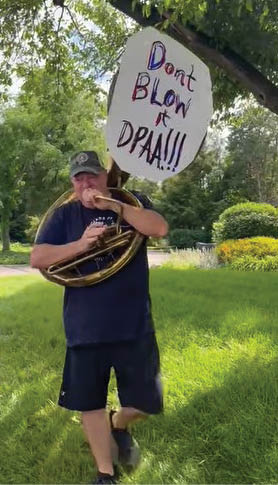
Principal Tuba Timothy Northcut lets the sousaphone do the talking while protesting DPAA programming cuts.

Musician involvement has proven effective. “It’s clear our members don’t just want to sit on the sidelines and feel powerless,” says Young. “We’ve found that the opportunity to participate in many of our action events has been a real boost. Musician attendance at our public rally and lobby meet-and-greets has been incredible. We’ve also hosted sign-making parties, potlucks, happy hours, and post-concert hangs, all with exceptional turnout. As awful as this fight is, the camaraderie in the orchestra is at an all-time high and that’s really helped with morale.”

Arnow says musicians have also been supportive with overseeing social media, and even financially, helping for example to ensure there are sufficient funds to purchase t-shirts and other supplies. “Some have helped with graphic design tasks, and many have volunteered with the pre-concert leafleting and meeting the audience before performances.”

The Fight Ahead

In continued negotiations, Arnow says the DPAA has since added two orchestral services to their proposal. “However, these services are ‘paid for’ through eliminating travel compensation for subs and extras. Many musicians commute from Cincinnati or Columbus, so this would be a huge problem. In general, management seems very agreeable to nonfinancial things we propose, but we are very far apart financially,” he says.

If there is no positive response to either the musicians’ demands or public pressure, Arnow says the PC plans to keep all options on the table. “As we near the end of this contract and the start of next season, we need to keep up pressure on the board to find a better path forward. The board needs to create and enforce a culture of accountability among the staff.”

“We can’t accept a future that shrinks our performances, artistic output, and opportunities to serve our community,” says Young. “It’s particularly insulting that they are paying enormous sums of money—which they insist they don’t have available to pay the orchestra—to engage a labor lawyer to make sure they get their way. That speaks volumes, and we need to be ready to use all tools we have available.”

In the meantime, they are eager to share what they’ve learned with their colleagues in other orchestras facing similar challenges. Aside from making use of AFM resources for things like press and communications, Lassiter says musicians shouldn’t wait for a crisis to begin engaging with their colleagues. “Build the relationships you’ll need later, right now,” she urges. She says it’s important to have a good mix of strengths on the PC. “I’m good at logistics, and other members of the committee are good with financials. One member designed the logo on our t-shirts.”

Lassiter also recommends establishing a musicians’ online presence distinct from the orchestra’s official website. “Start a ‘Musicians of …’ social media page, and it will be ready when you need it. For organizing materials, check your local library for resources. We were able to use the Cincinnati library’s space to make buttons, stickers, posters, and leaflets at a very affordable cost.”

“Keep the high ground, however hard or upsetting the fight gets,” concludes Young. “We’ve encountered ample evidence that our management has significant disdain for the artists they have been hired to support, and that has brought up lots of big emotions from our members.” However strong those emotions, it is crucial to maintain professionalism and dignity. “We know the public will remember how we behave long after this. It’s so important to keep that in mind every step of the way.”


NEWS


https://totoabadi25.com/ abadicash abadislot Menara368 royalbola abadislot abadislot menara368 abadicash menara368 totoabadi Menara368