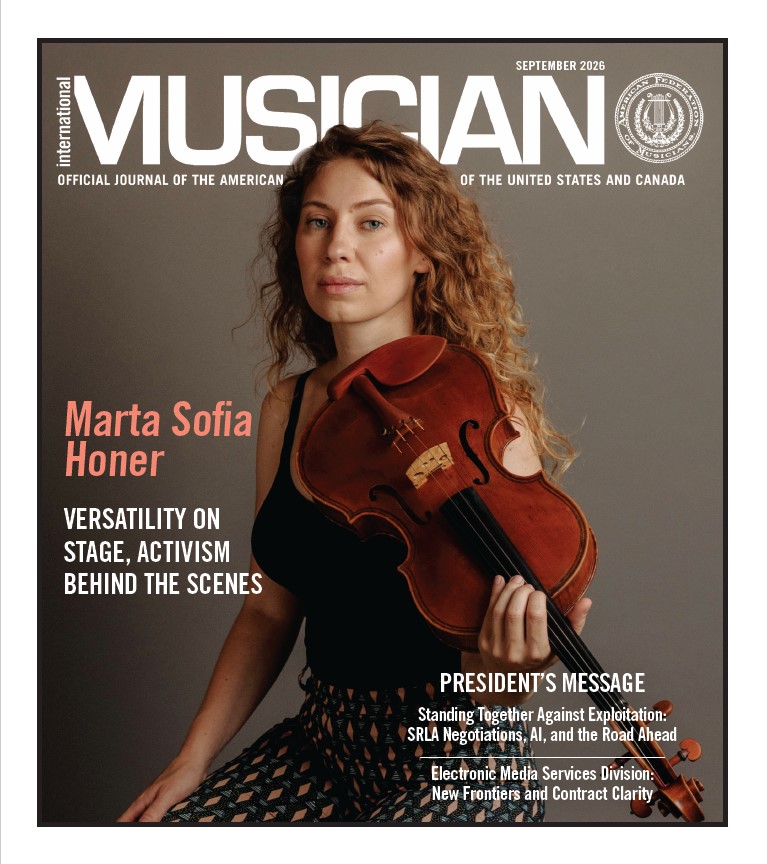
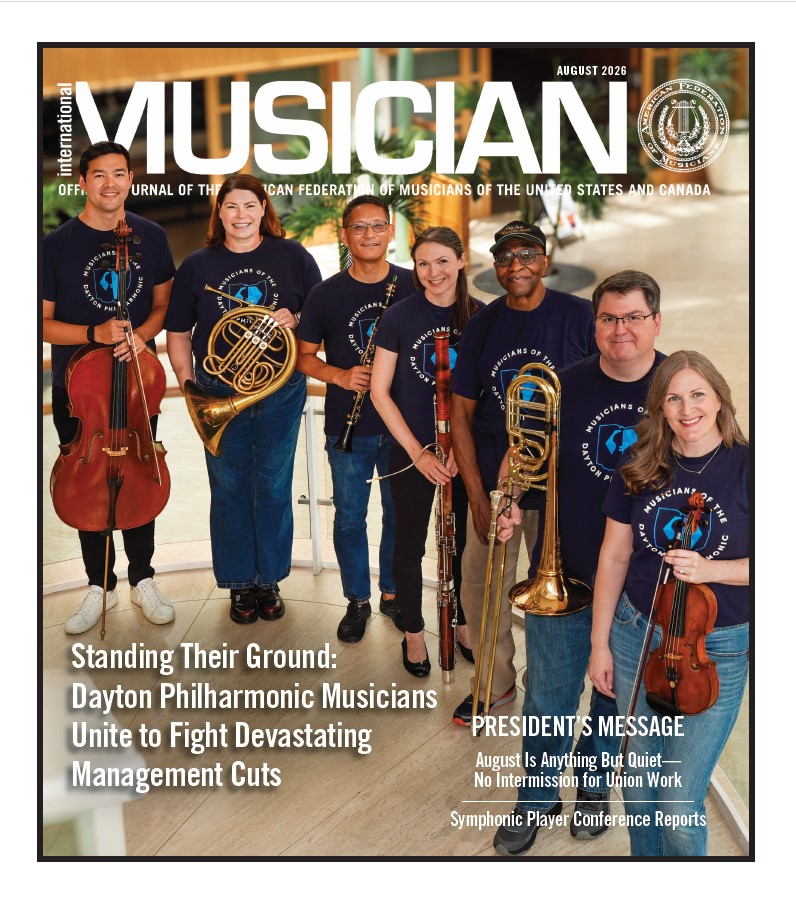
Now is the right time to become an American Federation of Musicians member. From ragtime to rap, from the early phonograph to today's digital recordings, the AFM has been there for its members. And now there are more benefits available to AFM members than ever before, including a multi-million dollar pension fund, excellent contract protection, instrument and travelers insurance, work referral programs and access to licensed booking agents to keep you working.

As an AFM member, you are part of a membership of more than 80,000 musicians. Experience has proven that collective activity on behalf of individuals with similar interests is the most effective way to achieve a goal. The AFM can negotiate agreements and administer contracts, procure valuable benefits and achieve legislative goals. A single musician has no such power.

The AFM has a proud history of managing change rather than being victimized by it. We find strength in adversity, and when the going gets tough, we get creative - all on your behalf.

Like the industry, the AFM is also changing and evolving, and its policies and programs will move in new directions dictated by its members. As a member, you will determine these directions through your interest and involvement. Your membership card will be your key to participation in governing your union, keeping it responsive to your needs and enabling it to serve you better. To become a member now, visit www.afm.org/join.

FIND OUT MORE ABOUT THE AFM


Home » Member Profiles » Allene Hackleman


Allene Hackleman

  -  

Leading by Example and Elevating Women in Brass

With a dad like Martin Hackleman—known to brass players around the world as a former horn player with the legendary Canadian Brass, and subsequently the Empire Brass Quintet—one might think that the horn was inevitable for daughter Allene. Not so.

“I actually started on the clarinet,” says Allene Hackleman, a Vancouver native, member of Local 390 (Edmonton, AB), and principal horn of the Edmonton Symphony Orchestra since 2004. “But I guess it’s no surprise that the clarinet ultimately wasn’t a great fit.”

Hackleman recalls that she entered eighth grade in a different school system where most of her peers were only choosing an instrument for the first time. “Since I’d been playing the clarinet for a few years already, I thought band was going to be pretty boring for me. But it turned out nobody wanted to play the horn. So, I said, why not?”

She adds that there was also a slightly practical side to the switch: “My dad’s partner at the time was also a horn player, so it was just all horn, all the time on the weekends when I was with them, and I knew I could get some lessons.” Her dad’s reaction, on the other hand, was not quite what you might expect: “I declared that I was going to play the horn, and he asked, ‘Are you sure?’”

Learning the Ropes

In lessons, she says, her dad was pretty hands-off, and there was zero pressure. “It definitely wasn’t a ‘born with a horn in your hands’ situation,” she laughs. “Of course, there’s a huge advantage to hearing great horn playing around you at home, because he was a big practicer. Growing up, hearing that sound, rockets you forward. Because you know what the horn is supposed to sound like, it’s so much easier to get there yourself.”

Lessons, she says, were also low pressure. “It was easier because we didn’t live together. I would see my dad on the weekends, which was better because then he didn’t hear how I wasn’t practicing during the week.” Mostly, she says, they would just play together, duets or trios. “It wasn’t super formalized. It always felt more like he was just helping me out. I never felt like, oh God, I’ve gotta perform.”

It was that absence of tension, Hackleman believes, that helped her decide on her own that an orchestral career was for her. “Even before I went away for high school at Interlochen [Arts Academy], I knew I wanted to pursue being a performer,” she says. “As I progressed, an orchestral path was the one that organically made the most sense, because I loved the repertoire.”

Hackleman ultimately completed her undergraduate degree at the University of Cincinnati and has since performed with orchestras across Canada, both as an orchestral player and soloist. She also enjoys performing in chamber ensembles whenever she can escape from her symphony schedule in Edmonton and a busy family life with her son, cat, and husband, which she lists in that order.

Leading by Example

Winding up with a job as principal horn in a major Canadian orchestra took a bit of mental adjustment, Hackleman says. Horn sections are peculiar in that each position—from assistant down to 4th horn—requires some degree of specialization. The odd numbered seats typically play in the high register, while the even-numbered ones usually cover the lower parts. Principal horn leads the section and is the most soloistic of the five.

“I was taking any auditions that came up, but I’m definitely stronger as a high player, so I didn’t seek out the low horn auditions,” Hackleman says. “I also don’t consider myself a natural leader or overly confident person, something I’ve had to learn on the job,” she admits. “My approach has always been to lead by example. I produce the best playing I can at all times, and assume that’s enough to show the section how I believe the music should sound.”

Also, she says she’s learned the importance of being positive while at work. “Telling people what to do isn’t my style, because it’s too easy for people to take offense or feel like they’re being criticized,” she elaborates. “On the job, I’ve learned to get a read on people and know when to push or when to leave things alone. Confronting someone who gets their back up easily will just make the relationship more tense.”

Far more effective instead, says Hackleman, is fostering a healthy environment. “I’m also blessed with colleagues who are wonderful people. The longer I’m in this business, the more that’s worth its weight in gold. You can play in the most amazing orchestra ever, but if the environment is toxic or you don’t click with your colleagues, you can feel isolated.”

Hackleman is especially grateful for her situation because she knows that’s not always the case with a group of people who work so closely together in a job that requires a high degree of trust. “We all hear of instances where someone is really miserable because of something negative happening in their section a few chairs down. I feel like we have a very friendly orchestra in Edmonton, and the culture overall here is positive and supportive,” she adds.

Women Brass Players

Another area where Hackleman has learned to be a leader is in her role as a prominent woman brass player in a historically male-dominated field. By default, that would also seem to make her a great role model for other aspiring Canadian women brass players.

“Well, I hope I am, anyway,” she demurs. “In Canadian orchestras, we have so many great female principal horns laying it down in Calgary, Montreal, and Winnipeg, just off the top of my head. As I am inspired by all of them, I hope that I can be that for someone else, too.”

Hackleman says she often dreams of getting them all together to form a Canadian women’s horn ensemble. In the meantime, she has participated in a group called the Canadian Women’s Brass Collective. Such visibility is crucial, she feels, so that younger women can see themselves doing the same thing. She was a featured artist at the International Women’s Brass conference in 2010 in Toronto, and adds that she is proud of the fact that the Edmonton Symphony has all female wind principals. “Principal flute, oboe, clarinet, horn, and bassoon are all women here. Visibility doesn’t get much more visible than that.”

Asked about what advice she might have for hopeful Canadian women brass players, she takes a long moment to think. “It’s an important question,” she says. “First and foremost, you have to uphold the highest standard of excellence for yourself. But also, acknowledge that you deserve to take up space in the room.”

As with leadership skills, Hackleman admits this is something she herself has had to learn. “It can be hard to inhabit this philosophy, especially for those of us who are naturally more introverted. But it’s incredibly powerful to have a collective voice. The more female brass players who are out there killing it, the more we all feel that support, and the more we believe we can all do it. As female brass players, we always need to say things in support of women who may not even be in the room. It’s just as important as being a great player and a great musician.”

Hackleman takes her role as educator as seriously as she does being a principal horn player in a major Canadian orchestra. She has taught at the Musikacademy in Belgrade, Serbia, as well as the Domaine Forget Academy in Quebec and the National Youth Orchestra of Canada. She currently teaches at the PRISMA Festival, at the Rafael Mendez Brass Institute in Denver, Colorado, over the summers, and is on the faculty of the University of Alberta.

“We’ve all had important formative experiences where our teachers made us feel like there was something magical about what we do. If we have the opportunity to pay that encouragement forward, we should absolutely do that. Our students deserve to have a shot at doing this,” she says.

Collective Support

Hackleman believes the power behind having a collective voice extends naturally to union membership. She joined Local 1 (Cincinnati, OH) back in her undergrad years and believes collective work can be equally valuable through committee work in an orchestra.

She has served many terms on her orchestra’s artistic leadership committee, which came out of a strike that happened in 2005 that led to changes in governance within the orchestra. A standing committee of the board, it includes five musician members as well as representatives from the board and orchestra administration. “The goal is to give us a powerful voice in the organization,” she says. “Every orchestra musician should take a turn on a committee and do their part to keep things running smoothly.” Hackleman agrees that it can be a challenge to get younger musicians interested in joining committees—a factor also in common with the union. She feels that comes down to education.

“It’s our responsibility to inform younger musicians about what union membership really means. I don’t think I understood that at all when I was younger. I was just like, ‘well, you have to join the AFM because you got this gig.’ The common attitude is annoyance: now I have to pay dues and it’s going to cut into what I’m earning. Younger musicians need to know about the value of the union, what they get out of their dues, and why that’s important.”

A good example, she says, is when a contractor or hirer approaches a younger musician with a terrible offer. “A young musician might understand that the money seems really low for the amount of work—but they can ask someone more experienced and go back to the contractor armed with the knowledge of what they should expect to be paid.”

This most recent Labor Day, Hackleman says, reinforced the importance of unionism for her. “Labor unions have unfortunately fallen behind in the popular zeitgeist. In the current climate, it’s more important than ever to stand firmly behind our collective power and the strength we gain from it.”

Hackleman says even a quick look at the headlines demonstrates how forces like huge union-busting corporations are attempting to weaken collective strength and dismantle it. “It affects us all. Workers in any field will not get anywhere without strength in numbers and cooperation.”


NEWS


https://totoabadi25.com/ abadicash abadislot Menara368 royalbola abadislot abadislot menara368 abadicash menara368 totoabadi Menara368