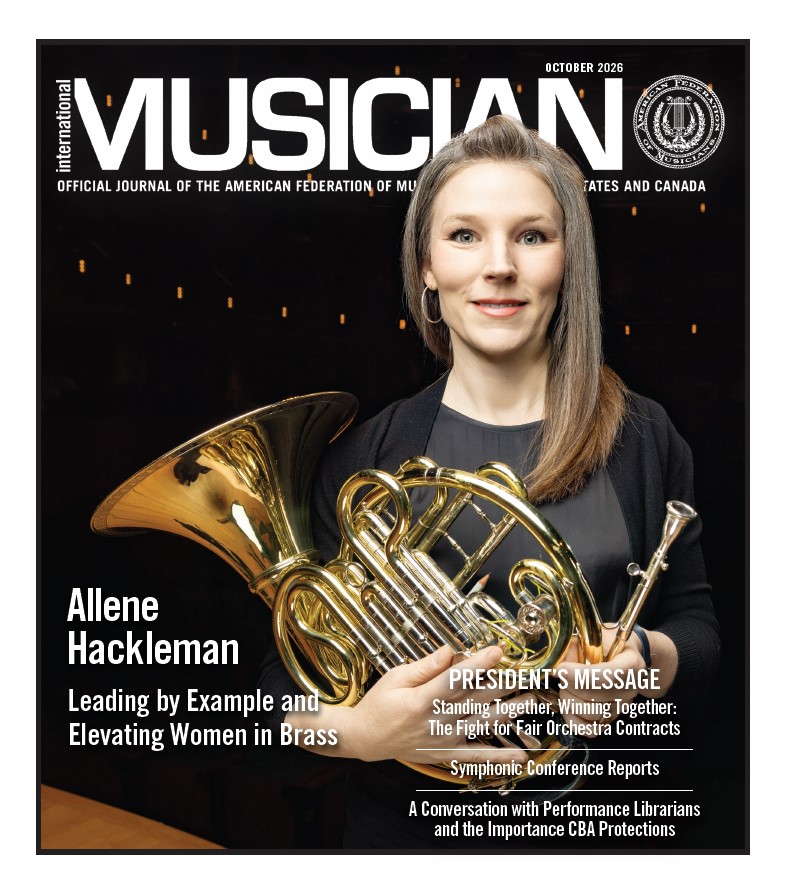
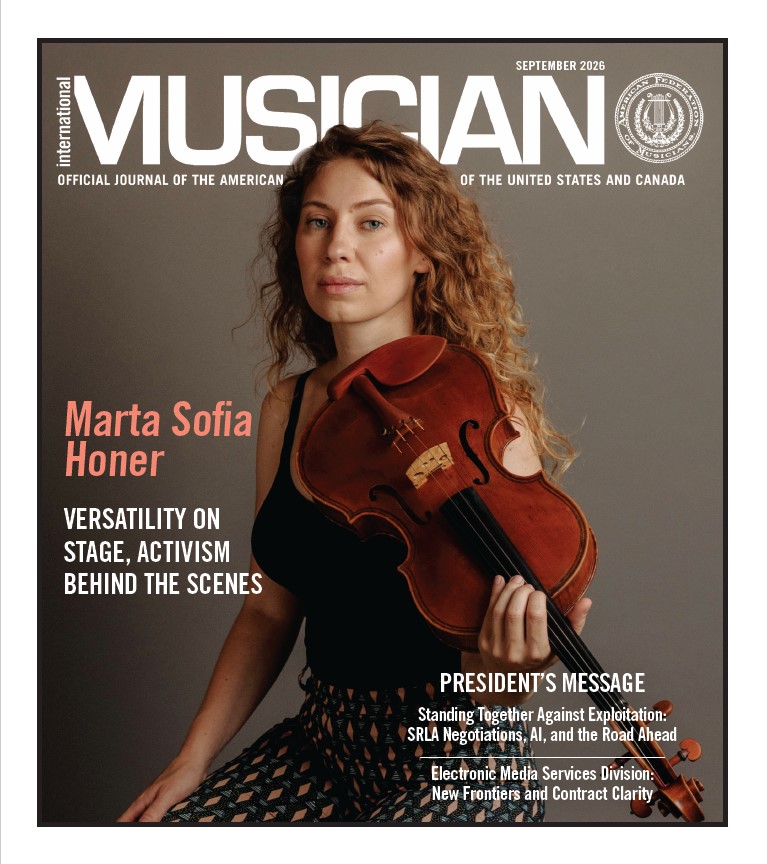
Now is the right time to become an American Federation of Musicians member. From ragtime to rap, from the early phonograph to today's digital recordings, the AFM has been there for its members. And now there are more benefits available to AFM members than ever before, including a multi-million dollar pension fund, excellent contract protection, instrument and travelers insurance, work referral programs and access to licensed booking agents to keep you working.

As an AFM member, you are part of a membership of more than 80,000 musicians. Experience has proven that collective activity on behalf of individuals with similar interests is the most effective way to achieve a goal. The AFM can negotiate agreements and administer contracts, procure valuable benefits and achieve legislative goals. A single musician has no such power.

The AFM has a proud history of managing change rather than being victimized by it. We find strength in adversity, and when the going gets tough, we get creative - all on your behalf.

Like the industry, the AFM is also changing and evolving, and its policies and programs will move in new directions dictated by its members. As a member, you will determine these directions through your interest and involvement. Your membership card will be your key to participation in governing your union, keeping it responsive to your needs and enabling it to serve you better. To become a member now, visit www.afm.org/join.

FIND OUT MORE ABOUT THE AFM


Home » Member Profiles » CHARLIE WORSHAM


CHARLIE WORSHAM

  -  

Blurring the Lines: Sideman, Session Player, and Solo Artist

Rising country artist Charlie Worsham of Local 257 (Nashville, TN) is forging his career with intelligent lyrics and thoughtful music making. At the same time, he is following his own unique path as a solo artist.

Worsham, a Mississippi native, believes that all music is storytelling. And he is happy to share some musical stories of his own, starting with how he got his first electric guitar, a Telecaster, from a music store in Nashville when he was still in school.

“I’d saved up 500 bucks, but the one I wanted was $600,” he recounts. “I had my banjo with me, so I played outside for tips for two hours. And then I walked back into the store and walked out with a Telecaster.”

That story also serves as a metaphor for Worsham’s own career as a self-starter: if you want something, believe you can do it, and then make it happen.

Finding the Lane

Worsham says his earliest musical memory was sitting on his drummer father’s lap in front of a drum kit and banging on the drums. “That’s a bond that we’ve shared throughout my life, and it was followed by so many great memories of him taking me to concerts and stoking my interest.”

Music was just something that Worsham did naturally and would keep on doing. “I was not cut out for athletics,” he laughs. “Nothing else really took once I started piano lessons in kindergarten. After that, I found my lane and I never looked back.”

Worsham got his first banjo in second grade and started taking lessons. A guitar followed in fifth grade, and he started teaching himself. In high school, he joined a bluegrass band that included older musicians who his dad had played with, starting before he was born.

“Back when I used to watch them as a kid, I thought, I don’t know what this is, but I want to be a part of it,” recalls Worsham.

The next step was playing drums, bass, and electric guitar in a bar band. “It was such a great training ground,” he says. Worsham enrolled in Berklee College of Music—but made a beeline to Nashville.

He currently plays with Local 257 member Dierks Bentley’s touring band and toured with Local 257 member Taylor Swift in 2011. He has also performed and recorded with a host of well-known country artists including Eric Church, Kacey Musgraves, and Carrie Underwood. As a songwriter, Worsham’s songs have been recorded by Dierks Bentley, Kenny Chesney of Local 257, and Luke Combs. He is just about to release his latest solo album.

“My biggest influences were B.B. King, Vince Gill, Marty Stewart, and the guitar players in Lynyrd Skynyrd,” he says. He also mentions Earl Scruggs—and marvels how his musical life has come full circle: “I’m closing in on 20 years in Nashville, and here I am talking to you from the dressing room in the Country Music Hall of Fame where I first shook Earl Scruggs’s hand. The wonder of it has never worn off. I don’t think that ever does. But now I’m more confident in feeling like I have something to bring into the room,” Fittingly, Worsham was also voted the 2024 Country Music Association (CMA) Musician of the Year.

Keeping Up the Chops

Impressive list of achievements aside, Worsham is the first to admit that his career path has never been focused solely on one thing. “When I got my first record deal, the conventional wisdom was that a multi-hyphenate career would work against you,” he recalls. “You were expected to pick one thing, and that’s what you got to be. But what I’ve found in the last five or six years is that the opposite is true. We are in a time where the more hats you can wear, for as long as you can, the better—as long as there’s one critical ingredient in the mix—you have to be a good storyteller.”

As a prime example of his versatility, Worsham shifts nimbly among guitar, banjo, and mandolin, despite the very different techniques required for each. Admittedly, he says, keeping up all three requires diligent work. This is particularly true with the mandolin, which, he explains, is a more percussive instrument and is tuned in the opposite way from a guitar.

“I did have a mandolin growing up,” he says. “I learned a handful of chords and some fiddle tunes, but I didn’t really build out my mandolin chops until the last few years. When you’re on the road, you have a lot of downtime in a hotel room or bus.”

To that end, Worsham says he sets an annual mission to make his downtime useful. “That might mean focusing on acoustic guitar one year. Or maybe learning some Lynyrd Skynyrd guitar solos on a deeper level than I ever had. Over the last couple of years, mandolin has been that project. I learned when I first started touring extensively that just because you might know that 45-minute set of music, it doesn’t mean your chops are really sharp. You’re just sharp at that particular set of material.”

Of course, he points out, focusing on one thing can lead to neglecting something else. “On the banjo, I feel like I used to have a better skill set and that I’ve let it fall off. So now, I’m eyeing the banjo as my next downtime project, probably to the dismay of whoever I’ll be on tour with.”

Shifting Gears: The Solo Path

Asked about making the transition from sideman to solo artist, Worsham demurs. “My first few years in Nashville, I was a part of a band,” he says. “Especially as an only child, it was a chance for me to work with a group of people who were in a real sense the brothers I never had growing up. And I had this beautiful opportunity to travel across the country.”

He feels that he was always following both tracks. “I was learning how to operate in a band and how to listen to the other players. At the same time, I was also learning how to entertain, and how to write songs on the singer-songwriter side.”

The COVID-19 pandemic produced another turn on the career path. “In common with everyone else in 2020, everything just kind of hit pause,” he recalls. “I still wrote songs, and I still went into the studio and recorded material for my own records. But what really changed was the money I would have made touring that wasn’t there.”

Worsham says he compensated by putting his name in the hat in the session player community. “I was like, hey man, I’m obviously not touring and I can throw on a mask and join you in the studio—and my session playing career really took off.”

The Human Element

After years of being a self-starter, Worsham has some solid advice for budding country artists wanting to make a name for themselves. Unsurprisingly, it all starts with storytelling. “First, know your own story and know how to tell it,” he offers. “Second, don’t be afraid to learn a little bit about a lot of different things. For instance, how to run your own social media, and how to make a record that you fund yourself.”

He also says it’s important to remember the listener and think about who your audience is. “Ask yourself how you can get great at telling stories, and what are the unique stories you have to tell? Audiences want to be moved emotionally by a song, or by the way you bend a note on the string,” he says. “They want to hear something that makes them say, wow, whoever is playing on this record knows how I feel.”

He adds that, while it’s important to understand what’s happening in the marketplace, you shouldn’t let it impact your art. “Just let it influence what type of frame you build around it, if that makes sense,” he says.

Worsham is also a fan of embracing media outside of music. “My mom is a lifelong educator and believes in being a lifelong learner,” he says. “I inherited that same sense of curiosity from her.”

In 2024, Worsham began hosting a podcast called Mississippi on the Map, in partnership with Visit Mississippi. The podcast explores Mississippi’s contributions to music which, he says, “are vast and deep and complex.”

While podcasts might be a modern medium, Worsham says they are built on the most ancient form of human community relationship building that we have. You guessed it: storytelling.

“Podcasts are also the one thing that is immune to AI,” he says. “Not that AI can’t spit out a good story for you. But real storytelling, like a really true song, goes all the way back to your seminal memories and influences: being able to know what water out of a garden hose tastes like. Or how much salt is in those tears, how warm they are on your cheek. And how your breath feels when you are grieving.”

Union Strength

Exploring new ways to earn a living while building a functional career is why Worsham continues to embrace unionism. “Early in my Nashville days, I was pretty broke,” he remembers with a chuckle. “There was a year or two in there where I literally played just enough sessions to cover my union dues. A couple of the guys in the band didn’t have health insurance and I thought man, that’s kind of risky. Then, I saw something on a wall about that from the AFM when I was picking up a check. And so, for quite a while I got my health insurance through Local 257.”

Worsham says he remembers how much of a relief that was, and the peace of mind that came with it. As he started getting more calls for session work, he also began to understand how some of his money was going into the AFM pension fund toward his long-term security. “The longer I’ve lived in Nashville, the more I’ve come to be grateful for filling in my name on a timecard, seeing how much I’ll get paid in that check, and where that money goes.”

That’s just the tip of the iceberg of what the AFM does, he adds. “Especially right now, as we approach this new age of AI, we have people at the union looking at ways to protect our artistic output. The union has evolved with the times. This recent album I made that I funded on my own is a low-budget record. Because of the AFM, I was able to take care of my friends on the record, but also not go broke making it.”

Between the AFM and serving on the CMA board, Worsham says he has also learned the importance of having a process people can agree on, and through which they can voice their concerns.

“Knowing that you’re not alone is critical. Being part of a community is so important, and the union is a community I’m proud to be a part of. I remind myself of that when it’s time to pay dues or contract writing fees, because people are working hard to make sure that I’m treated fairly. There really is power in banding together.”


NEWS


https://totoabadi25.com/ abadicash abadislot Menara368 royalbola abadislot abadislot menara368 abadicash menara368 totoabadi Menara368