Now is the right time to become an American Federation of Musicians member. From ragtime to rap, from the early phonograph to today's digital recordings, the AFM has been there for its members. And now there are more benefits available to AFM members than ever before, including a multi-million dollar pension fund, excellent contract protection, instrument and travelers insurance, work referral programs and access to licensed booking agents to keep you working.

As an AFM member, you are part of a membership of more than 80,000 musicians. Experience has proven that collective activity on behalf of individuals with similar interests is the most effective way to achieve a goal. The AFM can negotiate agreements and administer contracts, procure valuable benefits and achieve legislative goals. A single musician has no such power.

The AFM has a proud history of managing change rather than being victimized by it. We find strength in adversity, and when the going gets tough, we get creative - all on your behalf.

Like the industry, the AFM is also changing and evolving, and its policies and programs will move in new directions dictated by its members. As a member, you will determine these directions through your interest and involvement. Your membership card will be your key to participation in governing your union, keeping it responsive to your needs and enabling it to serve you better. To become a member now, visit www.afm.org/join.

FIND OUT MORE ABOUT THE AFM


Home » Member Profiles » Chutzpah and harmony


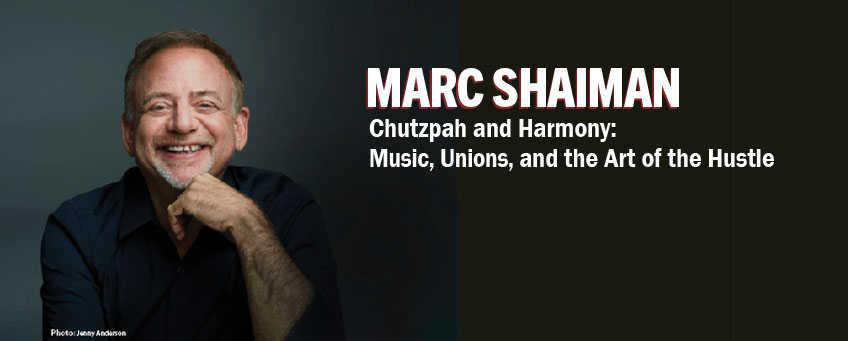
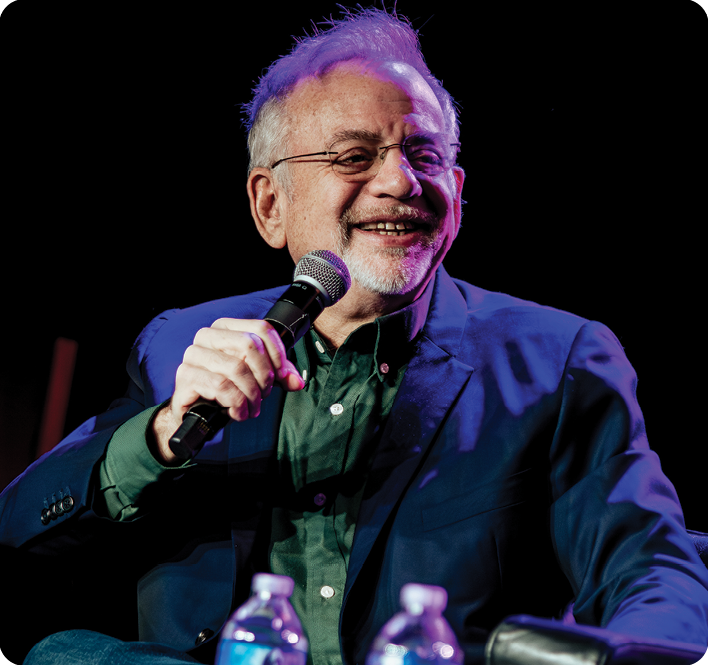
Chutzpah and harmony

  -  

With a slightly self-deprecating laugh, Marc Shaiman says his friends call him Eeyore, after the chronically pessimistic donkey from the Winnie the Pooh stories. He seems to wear the nickname like it’s his brand. But talking with Shaiman, it’s hard to square that with the irrepressible enthusiasm that comes through—despite the obvious exhaustion that comes with burning the candle at both ends and the middle.

The Reluctant Retiree

“I meant to retire this year,” sighs Shaiman, a longtime Local 802 (New York City) member and perpetually working pianist, arranger, composer, and co-lyricist of the Broadway smash hit Hairspray, among hundreds of other credits. “But that’s obviously not working out.”

Indeed, it’s not: Shaiman currently finds himself in the middle of writing the music for Billy Crystal’s one-man show coming to Broadway this fall. He has also been rehearsing for another show where he plays … a piano player. “That show must remain nameless because it’s still a secret,” he says.

In between these projects, he’s working with Broadway legends Patti LuPone and Bridget Everett on a new show specifically for and about them.

“And meanwhile, I’m just narcissistically talking about myself at every given moment. Like, for instance, right now,” he laughs. “And right after this conversation, I’m flying to Los Angeles to talk with Michael Bublé at another event about my memoir.”

The Hamster Wheel of Fate

Even more than the sheer number of engagements, what’s especially fascinating is how all of Shaiman’s projects have seemed to emerge almost organically from each other: his writing and arranging for Bette Midler led to work on Saturday Night Live, which led to working with Billy Crystal and Martin Short, which led to composing music for films.

“The situations themselves give birth to the creativity,” Shaiman insists. “But when I look back on what is now 50 years of amazing opportunities coming at me endlessly, I think geez, this is enough for like five people.”

Shaiman says all of this work has felt at times like the wheel of fate. “Or maybe more the hamster wheel of fate. As we in the Jewish profession say, it was beshert [Yiddish, basically “it was meant to be”]. There are of course things I’ve said no to, or things that I’ve missed out on that I regret. But I got to spread a lot of joy through the things I’ve done.”

The urge to follow musical passions and opportunities started early, which is surprising given that Shaiman says there wasn’t much music in the house where he grew up in New Jersey. “My parents didn’t really play music in the house, not even records. It wasn’t like it was Footloose, where it was forbidden. But I just wasn’t surrounded by it.” Nevertheless, he says music, lyrics, and piano playing pretty much came naturally to him.

One of the early clinchers, Shaiman remembers, is hearing the 1964 Mary Poppins soundtrack for the first time. “I became obsessed. I wasn’t old enough yet to think about music as a career choice. But I understood instinctively that this is a thing I could do, and it was clear to me that I was meant to do it,” he says.

Shaiman started writing songs for his cat and began taking piano lessons in the first grade, at age 6. By 12, he had immersed himself in the local community theater scene, contributing to productions through junior high school music programs and summer workshops. He maintains that Mary Poppins soundtrack became the cornerstone of his songwriting and arranging skills.

The Chutzpah to Say Yes

At 16, Shaiman left school with a GED, packed everything up, and moved across the Hudson River to New York City. He says he has no real memory of being fearful. “I was already starting to get jobs and I loved working,” he recalls. “I had already been involved in community theater nonstop for three years, so my parents saw that I had a solid work ethic. I was enjoying myself and I was able to make great friends.”

He credits his community theater background with several foundational skills like harmonization and being able to put together bands. “Also, my junior high school years, where we did talent shows and I figured out the basics of how to put on a show,” he says.

Aside from his inherent abilities, Shaiman is grateful for another gift: having faith in himself. “I just never questioned it. Things happened for me so early that I almost didn’t have time. There were some moments of things not working out and me winding up being nearly broke. But in the world of paying dues and seeing what some of my friends have gone through to achieve success, I know I got off easy.”

Shaiman’s own success recalls the age-old question: how much is accomplishment achieved through sheer talent, versus sheer hard work? While he politely demurs at giving advice to younger musicians, Shaiman agrees that the talent is of course necessary—but so is preparation.

Another Yiddish word: “Chutzpah [drive, audacity, or insolence]. I have learned over the years, just say yes to everything. Because you never, ever know who is going to be in the audience, or who is listening to the audition that you didn’t get but remembers you six months later for something else. It’s unpredictable,” he says.

But also, cautions Shaiman, if you can think of doing anything else, do it. “This profession is only made for people who simply have to do it. In my case, I had no choice. There is nothing else I can do,” he laughs. “Seriously, the older I get, the more helpless I become. Thank God for my husband. He steers me in the right direction.”

The Sore Winner’s Trophy Room

Shaiman’s body of work is a clear indicator that he has (almost) always managed to go in the right direction just fine on his own, husband notwithstanding. His film credits alone include hits like When Harry Met Sally…, City Slickers, The Addams Family, Sister Act, Sleepless in Seattle, A Few Good Men, and The American President. One of Shaiman’s more fun projects, he says, was cowriting some of the “spicier” songs for South Park: Bigger, Longer & Uncut.

For the small screen, Shaiman worked on dozens of projects including helping to craft Bette Midler’s performances for Johnny Carson’s final Tonight Show and Billy Crystal’s performances for both of Jay Leno’s final Tonight Show broadcasts.

Along the way, Shaiman has earned seven Academy Award nominations, a Tony for the musical Hairspray, as well as two Grammys for the musicals Hairspray and Some Like It Hot, all shared with co-lyricist Scott Wittman—who Shaiman calls “my first soulmate”—and two Emmys, one for cowriting Billy Crystal’s Academy Award performances and the other for “Which of the Pickwick Triplets Did It” from Only Murders in the Building. He was also nominated for a Grammy for his arrangements for Harry Connick Jr. and received Emmy nominations for his work on Saturday Night Live and Smash.

In 2002, Shaiman was honored with the Outstanding Achievement in Music-In-Film award at the Hollywood Film Festival. In 2007, he received ASCAP’s Henry Mancini Award in recognition of his outstanding achievements and contributions to the music of film and television. Another Emmy nomination came his way for musical direction and cowriting on the 82nd Academy Awards in 2010.

The Power of Musical Protest

The AFM has been a part of Shaiman’s professional life for decades, and he has been a member of Local 802 since the late 1970s. “Early on, I understood that being a union member was necessary,” he says. “I was doing a lot of cabaret jobs back then as a piano playing arranger.” He believes having union protection to help guarantee the paychecks was crucial.

Shaiman has never shied away from vocalizing what he believes needs to be said. “I remember getting yelled at during the Broadway run of Hairspray,” he recalls. “Someone brought Scott and I into a room and showed us how recorded tracks could be manipulated to follow the singers. And, of course, that has only gotten worse. Producers have made more and more money by shrinking the size of orchestra pits. So, one night when we were onstage for a curtain call, I took it upon myself to thank the audience for being there and I told them to support the union.”

The producers, he says, “tore me a new one” the next day. “They reminded me that they were the ones paying for the theater and they told me I had crossed a line. But I felt it was time to show support for the musicians.”

Musical protest has also taken other forms. In his recent memoir (more below), Shaiman describes living through the horrors of the AIDS crisis and is outspokenly heartfelt about its effects on a generation of gay men and its deep and indelible impact on the arts world.

In the case of same-sex marriage, Shaiman says, protest is tied into the gratitude he feels for filmmaker, actor, and activist Rob Reiner and his wife Michelle, both tragically murdered last year. “Over and above what Rob gave to my career and his friendship, he and Michelle were a huge part of the fight to get same-sex marriage passed by the Supreme Court.”

To that end, in 2008 Shaiman composed a satirical, star-studded, three-minute mini musical—partly inspired, he says, by the actions of the artistic director of Sacramento’s California Musical Theater, which had recently staged Hairspray. That same gentleman was outed as having donated to Proposition 8, a California ballot measure which aimed to ban marriage equality.

“The outrage over this led me to create Prop 8: The Musical. Little did I know at the time that I myself would actually get married in the future, and how meaningful it would be,” says Shaiman. Prop 8: The Musical has received over 4 million hits online, illustrating the reach of its impact.

The Full-Circle Journey

Because he obviously has lots of free time on his hands, Shaiman recently wrote what he calls “a tell-all, but also kind of a self-help book.” Never Mind the Happy—Showbiz Stories from a Sore Winner is a candid and often darkly funny look back over his five decades in the business, with chapters that have predictably hilarious titles like “I’m the Schmuck” and “I Killed Stephen Sondheim.”

Woven throughout the book and between the laughs is one clear and overriding feeling: Shaiman’s love for what he has been fortunate to do with his life, and his pride in the opportunities he has been given. Above all, he says, a few things stand out.

“First, I think, would have to be Hairspray. You know, I always wanted to have a musical on Broadway. It took me until I was in my 40s to have that dream come true. But to then have it come true in such spectacular fashion, to cocreate a musical that has spread such joy and with such a great message, was just magic,” he says.

Another career highlight has been his decadeslong collaboration with the famously outspoken entertainer Bette Midler. “I’m so proud of her. She has no f*cks left to give. She never had any, really, but now she just speaks her mind—or rather sings her mind—and I love her so much for that,” he says.

It seems only fitting that Midler played a small role in bringing Shaiman back to his original childhood inspiration. “It was wish fulfillment for me to write the score and songs for Mary Poppins Returns,” he says. “The night that Bette sang a song that Scott and I wrote for the film at the Academy Awards—that sound you heard was my head exploding. And, of course, Mary Poppins was my first inspiration, so it was a full-circle musical journey.”

An Oscar remains elusive, with Shaiman being an O short of an EGOT (the full sweep: an Emmy, Grammy, Oscar, and Tony). But he’s not bothered. Much. “I don’t obsess over that stuff,” he says. “You can make a long list of the iconic people from movies who never won an Oscar. Some of them were never even nominated. I was nominated seven times. So, it’s okay, and I’m … fine.” And then he laughs, sounding very much unlike Eeyore.


NEWS


https://totoabadi25.com/ abadicash abadislot Menara368 royalbola abadislot abadislot menara368 abadicash menara368 totoabadi Menara368