Now is the right time to become an American Federation of Musicians member. From ragtime to rap, from the early phonograph to today's digital recordings, the AFM has been there for its members. And now there are more benefits available to AFM members than ever before, including a multi-million dollar pension fund, excellent contract protection, instrument and travelers insurance, work referral programs and access to licensed booking agents to keep you working.

As an AFM member, you are part of a membership of more than 80,000 musicians. Experience has proven that collective activity on behalf of individuals with similar interests is the most effective way to achieve a goal. The AFM can negotiate agreements and administer contracts, procure valuable benefits and achieve legislative goals. A single musician has no such power.

The AFM has a proud history of managing change rather than being victimized by it. We find strength in adversity, and when the going gets tough, we get creative - all on your behalf.

Like the industry, the AFM is also changing and evolving, and its policies and programs will move in new directions dictated by its members. As a member, you will determine these directions through your interest and involvement. Your membership card will be your key to participation in governing your union, keeping it responsive to your needs and enabling it to serve you better. To become a member now, visit www.afm.org/join.

FIND OUT MORE ABOUT THE AFM


Home » On the Cover » True Concord Voices and Orchestra Musicians Secure Path to Union Election


True Concord Voices and Orchestra Musicians Secure Path to Union Election

  -  

Sometimes nonunion groups make the collective push for union protection because of a single large-scale event by an intractable management, perhaps pushing musicians into a corner. More often, the decision to unionize is the result of a series of restrictive or unacceptable work conditions that underscore a need to organize for the safeguarding and overall growth of the organization as a whole.

For the musicians of True Concord Voices and Orchestra (TCVO) in Tucson, Arizona, there was no proverbial straw that broke the camel’s back. Unionizing with Local 33 (Tucson, AZ) was clearly the best way for them to secure fair treatment, while also solidifying their rights and guaranteeing safe working conditions and equitable hiring conditions.

In March, TCVO musicians achieved their biggest victory in more than a decade of pushing to unionize: Region 28 of the National Labor Relations Board (NLRB) finally directed that a union election can proceed, marking a major milestone after several years of delays.

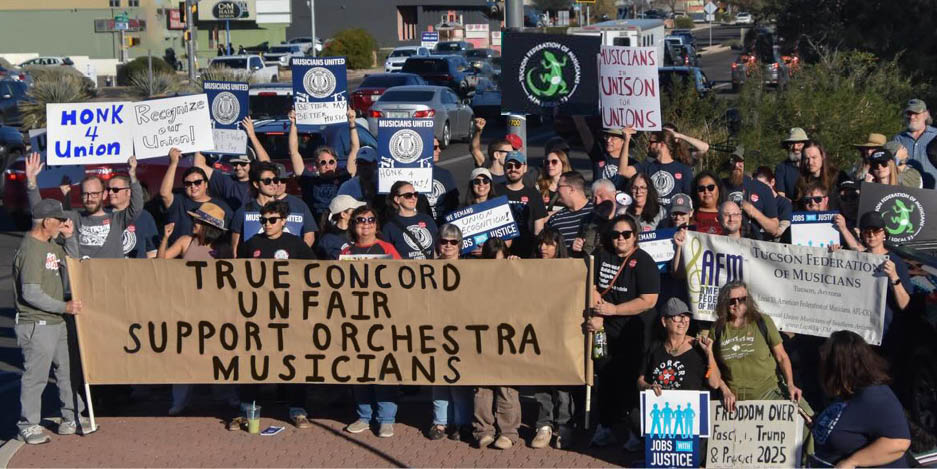
Through public demonstrations, informational leafleting, and a coordinated “Musicians United” campaign, the group has successfully brought their fight for a fair contract into the public eye.

Unfavorable Conditions

Violinist Ellen Ensey and violist Sarah Bromberg, both longtime members of TCVO and Local 33, agree that the push to organize was absolutely the result of a series of unfavorable contractual issues and work rules that over the years had become unacceptable in an organization with a unique artistic focus.

“True Concord is unusual in that it presents a combination of the great choral and orchestral masterworks along with commissioned pieces,” says Ensey, who also performs with the Tucson Symphony Orchestra and served as Local 33 president from 2016 to 2024. “Every season is different, and every program is different. I’ve also always had the feeling that TCVO is much more collaborative than your run-of-the-mill orchestra.”  

Bromberg, currently serving as vice president of Local 33, adds that most orchestras position the musicians front and center, with a volunteer-based choir engaged on an as-needed basis. “True Concord is different in that both choir and orchestra are professional, and both are featured prominently in programming,” she says.

A longstanding problem is that the TCVO board and management neglect to capitalize on this uniqueness. “True Concord has a regular subscription series and ostensibly aspires to grow the organization, but musicians are left completely in the dark about whether they will be hired for upcoming seasons, for how much work, and for which positions in the orchestra,” explains Bromberg, who has been with TCVO for a decade. “Some musicians can wind up getting completely ghosted after playing with the orchestra for years.”

Ensey concurs. “Job security has been an ongoing concern. Many of us have been with True Concord since its founding, yet we have no guarantee of work year after year,” she says. “It feels wrong that those of us who have helped to elevate this ensemble to its current status could be disposed of for no reason at any time.”

In fairness to TCVO management, she says that the organization has done a decent job with raw wage increases—but of course, she adds, “pay increases are meaningless if we lack any guarantee of work from year to year.”

Organizational Issues

Recording rights and conditions are also a problem, says Bromberg. “In order to accept work, we have to sign away all of our rights to recordings, which is highly problematic considering that the organization records all of our productions for broadcast and has completed several Grammy-nominated commercial recordings, with plans for more.”

Bromberg says this has long been the case at TCVO. “One True Concord musician relates a story about getting paid for their very first recording over a decade ago: at the end of the project, there were two stacks of papers. One stack was forms to sign away all individual musician rights to the recorded product. The other was the checks.”

This situation continues. “For two Grammy-nominated CDs recorded by TCVO,” says Ensey, “the musicians literally had to sign away rights to further compensation just to receive payment.”  

On top of these problems, elaborates Bromberg, safety issues abound. “The organization fails to provide hearing protection, while often cramming an entire orchestra and choir into spaces that are far too small, resulting in hazardous sound levels.”

Ensey maintains that, at a certain point, if an organization really strives to reach a more elite status, infrastructure needs to be in place to ensure consistency. “We needed to see guarantees on things like suitable space in venues, appropriate chairs, lighting, and distribution of marked parts on a clear timeline, with concrete work schedules given to TCVO musicians by a set date.”  

Organizing First Steps

Bromberg and Ensey both demur when asked who originally had the idea to organize. “We don’t really do titles on our organizing committee,” says Bromberg. “This organizing effort has always been driven by the orchestra musicians. Ensey, as a former president of Local 33, first pursued voluntary union recognition by TCVO in 2016. Unfortunately, that effort was stalled then due to legal and structural barriers.”

The campaign, she says, was ultimately revived in 2024 by the musicians. Since then, she adds, it has been propelled by exemplary guidance from the organizing committee with strong support from the orchestra and Local 33.

Ensey concurs that she asked the TCVO board for voluntary recognition in the summer of 2016. “At that point the organizing infrastructure at the AFM was not as robust as it is today, so once the board denied my ask, the project seemed to hit a dead end. All we could really do at that point was to continue talking among the ranks to keep the idea fresh in everyone’s minds.”

Both musicians agree that the process could not have moved forward without help from Local 33 and other area labor organizations. Local 33 President Alana Wiesing says a supermajority of TCVO musicians are seeking union representation. “Over 75% of the musicians have signed cards in support of union representation with AFM Local 33. This reflects the orchestra’s desire to have a voice at the bargaining table and to align the organization’s innovative artistic model with evolving industry standards, fair working conditions, and meaningful protections for the instrumentalists who make that work possible.”

Wiesing says the local was able to provide contact information for other unions, labor organizations, community groups, and news outlets in Tucson. “Establishing and developing those connections has been one of our most important goals. The way the community has supported and embraced this effort has been completely phenomenal,” she says.

Local 33 resources were also utilized to assist with the distribution of e-mails, flyers, social media content, and other campaign information locally and nationally, while Wiesing attended regular monthly Zoom meetings for the AFM Western Conference, Small Locals, and the newly chartered Freelance Musicians’ Association. “The information shared in those meetings by other experienced union leaders helped me bring their perspectives to TCVO organizing committee meetings,” Wiesing says.

Resistance and Delays

While the idea of organizing has been floated for more than a decade at TCVO, the recent timeline of events has been a bit more condensed, and largely characterized by foot-dragging and misinformation by the organization’s board and management. Throughout the process, explains Wiesing, TCVO has declined to voluntarily recognize the union, instead relying on delays in the NLRB process.

In June 2024, Local 33 filed a petition with the NLRB seeking union recognition and an election. “As a result, True Concord management retained outside legal counsel. During the NLRB hearings, management argued that the orchestra is not integral to the organization, an assertion that conflicts with the organization’s own mission and strategic planning documents.”

The case then experienced further delays due to a broader federal government shutdown.

Says Bromberg, “TCVO has been extremely avoidant throughout this entire process. The impression we’ve gotten is that they wanted this problem to just go away. Of course, we are not going to let that happen.”

“I would have liked to give the organization the benefit of the doubt,” adds Ensey, “but they ignored us and federal subpoenas for weeks. When it finally became clear that the issue was not going away, they spent more money on an attorney to fight it than it likely would have cost them to implement the changes we wish to work with them on. That just seems like a waste.”

Both Ensey and Bromberg say management’s communications to donors and patrons frequently mischaracterized the situation. For example, TCVO has described support for unionization as limited to “some” musicians despite a clear supermajority. Their messaging has emphasized their offered pay increase, while omitting key issues such as lack of job security, guaranteed services, safety protections, and recording rights.

In February 2025, musicians distributing informational leaflets at a performance were threatened with police involvement by a security officer, which could constitute an unfair labor practice. More recently, True Concord management has taken their resistance a step farther, recruiting a new nonlocal orchestra for the 2026-2027 season.

Public Support and Lessons Learned

Ballots were mailed to TCVO musicians on April 10, marking a major milestone in the push to organize after lengthy delays. They will be counted in mid-May. Bromberg, Ensey, and Wiesing all agree that the campaign would not have succeeded without the unwavering support of the musicians and the public alike, along with the backing of the broader labor community, including other labor groups in the greater Tucson area such as the Pima Area Labor Federation, AFL-CIO affiliates, IATSE Local 415, and Arizona Jobs With Justice.

“These are incredible organizations, and we owe them a debt of gratitude,” says Ensey. “Through them, we are able to amplify our campaign and learn from other bargaining units who have been through this before.” 

With the election scheduled, the focus has shifted to a celebration of this milestone and a call for management to respect the outcome of the vote and engage in good-faith bargaining moving forward. The musicians have engaged in a sustained public campaign, making use of op-eds, newspaper articles, donor communications, and a growing media presence. “Our first rally as a local happened on January 17, and we planned a public event to raise awareness on April 19,” Wiesing says.

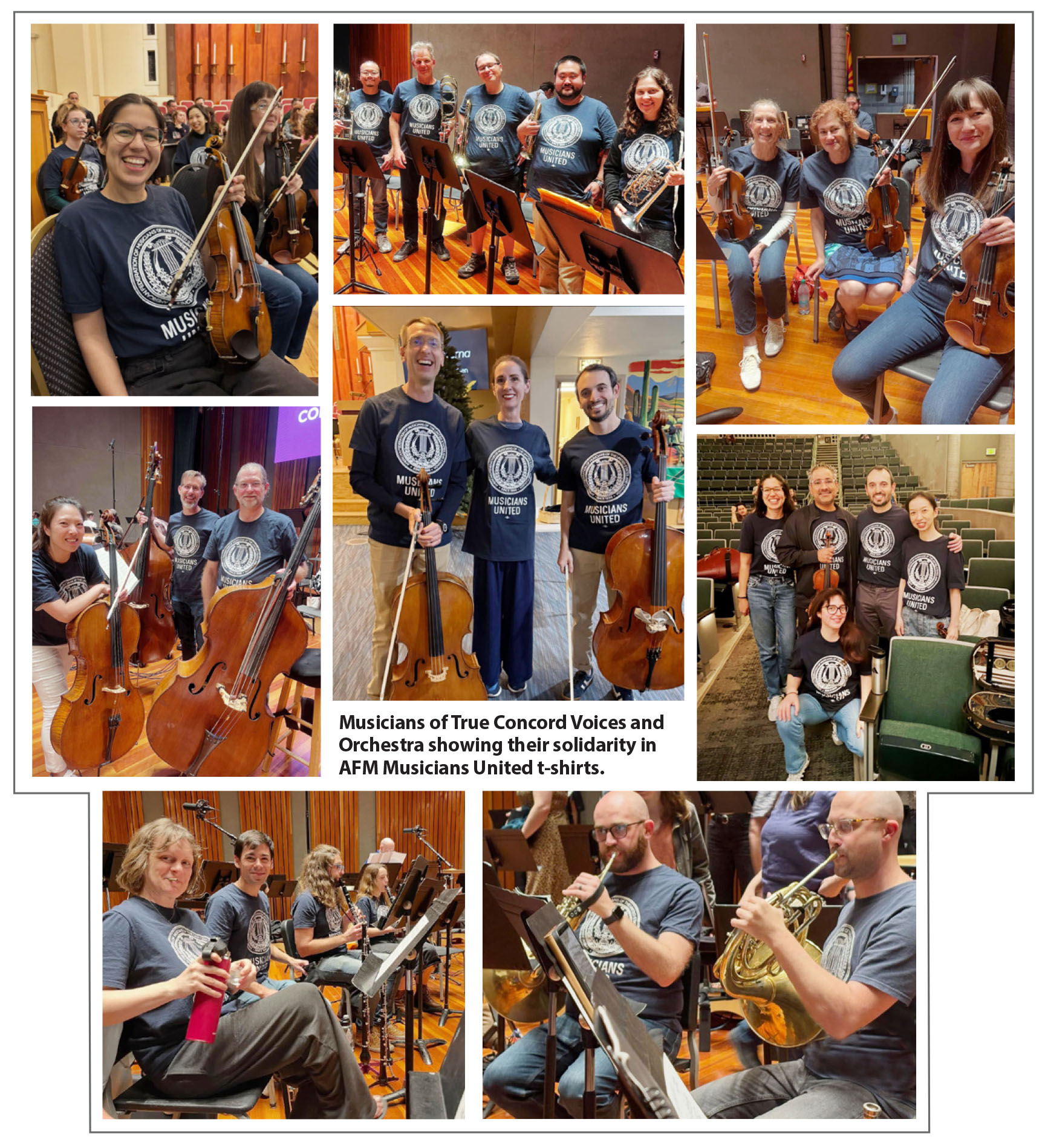
At Thursday dress rehearsals, says Bromberg, musicians wear navy blue AFM tee shirts. “We also have smaller groups of musicians stationed outside the lobby before performances to distribute pro-union literature and talk to patrons about our campaign.” 

Prior to the shift to election focus, there was a coordinated Action Network letter-writing effort to the TCVO board. “This sends an e-mail directly to board members encouraging them to recognize the union and come to the bargaining table in good faith.”

Bromberg adds her thanks and praise for the other members of the organizing committee. “Cellist Anne Gratz runs our social media accounts, and flutist Paula Redinger asks all the right questions,” she says. “Their commitment to engaging with workers has been crucial to maintaining support for our cause over the last two years.” To be successful, Bromberg believes, you need three things: First, a membership that is willing to take collective action; second, big support from your community; and third, detailed record-keeping. 

Also crucial, says Wiesing, is solidarity. “Solidarity that is persistent, visible, and unwavering will always find a way to succeed,” she believes. “I would urge union members to make the most of the excellent resources and connections that the AFM has to offer, including the Symphonic Services Division, the Organizing Services Department, the Education Department, and other labor leaders who have experienced an organizing campaign.”

Ensey concludes that the support of the community has been key to the organizing endeavor. “The public has really shown up for us, and we owe them a huge debt,” she says. She backs Wiesing’s conviction of the importance of solidarity. “If this whole process has taught me one thing, it’s that solidarity across the ranks is truly fundamental to achieving these kinds of victories.”


NEWS


https://totoabadi25.com/ abadicash abadislot Menara368 royalbola abadislot abadislot menara368 abadicash menara368 totoabadi Menara368