Now is the right time to become an American Federation of Musicians member. From ragtime to rap, from the early phonograph to today's digital recordings, the AFM has been there for its members. And now there are more benefits available to AFM members than ever before, including a multi-million dollar pension fund, excellent contract protection, instrument and travelers insurance, work referral programs and access to licensed booking agents to keep you working.
As an AFM member, you are part of a membership of more than 80,000 musicians. Experience has proven that collective activity on behalf of individuals with similar interests is the most effective way to achieve a goal. The AFM can negotiate agreements and administer contracts, procure valuable benefits and achieve legislative goals. A single musician has no such power.
The AFM has a proud history of managing change rather than being victimized by it. We find strength in adversity, and when the going gets tough, we get creative - all on your behalf.
Like the industry, the AFM is also changing and evolving, and its policies and programs will move in new directions dictated by its members. As a member, you will determine these directions through your interest and involvement. Your membership card will be your key to participation in governing your union, keeping it responsive to your needs and enabling it to serve you better. To become a member now, visit www.afm.org/join.
November 1, 2026
Tino Gagliardi - AFM International PresidentEvery note we play and every track we record comes from hard work and dedication. As musicians, we pour our energy into our craft. However, the rapid rise of generative artificial intelligence is challenging our livelihoods.
Negotiations for a successor Sound Recording Labor Agreement (SRLA) will resume November 3-5. Over the past year, we have been in negotiations with the major record labels—UMG, Sony, Warner, and Hollywood Records—to secure the best possible agreement for the musicians, music prep personnel, and artists who work on commercial tracks. However, negotiations have stalled over the labels’ refusal to agree to protective guardrails on AI development and generative music.
The labels have aggressively defended their copyrights against generative AI companies, filed high-profile infringement lawsuits, and insisted that AI models cannot train on recorded music without paying for it. At the same time, they are trying to deny the session musicians and artists who made those tracks a share of that revenue. They cannot claim copyright protection for master recordings while ignoring the human performers who recorded them.
In response, we filed a federal lawsuit against Universal Music Group, Warner Records, and Atlantic Records. We allege that these labels breached our existing collective bargaining agreements by licensing catalog recordings to AI developers, without paying musicians the required new use fees. Legacy contracts have long governed technological transitions from vinyl to streaming through new use provisions, and AI is no different.
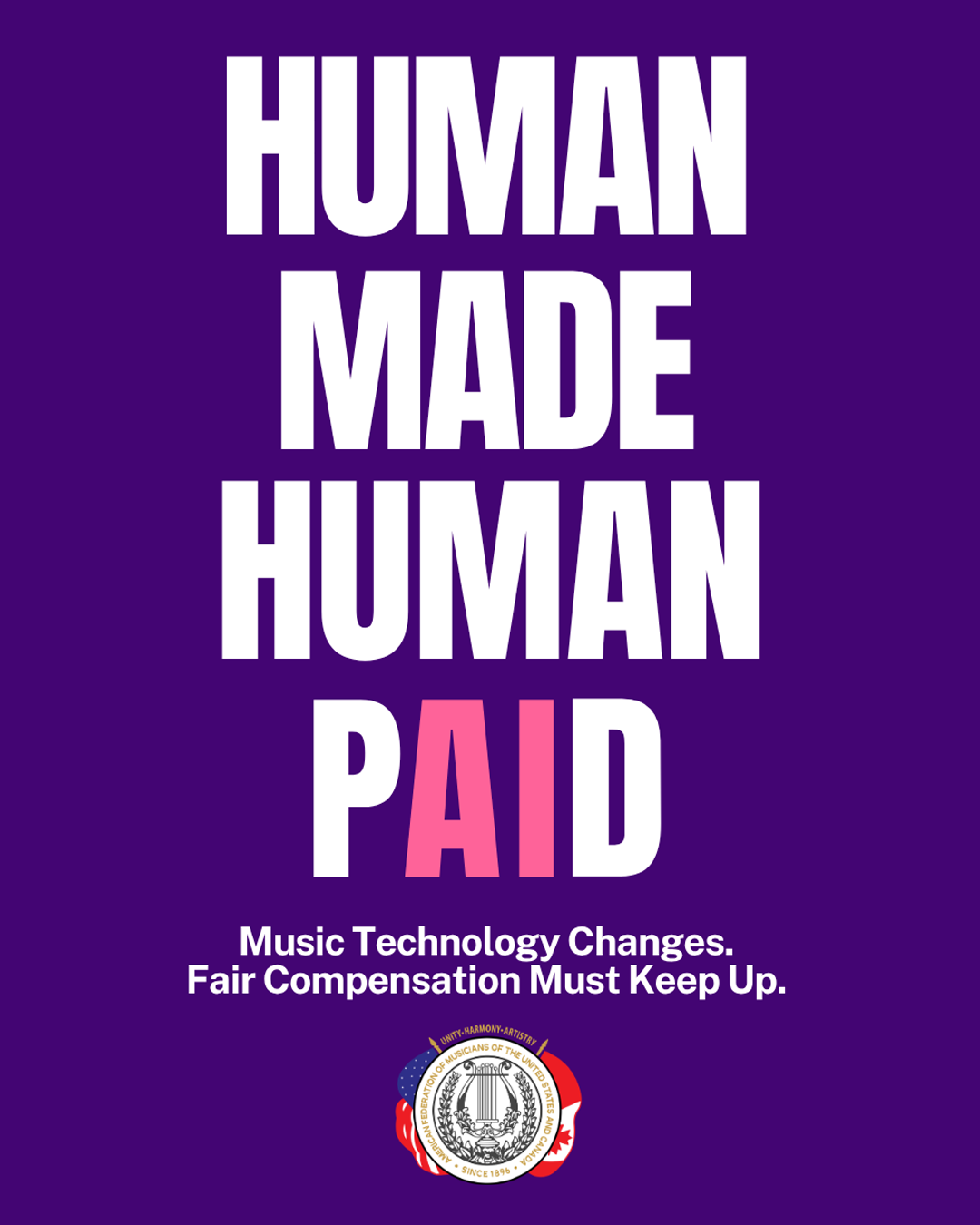
Ramping up to the November negotiations, we’ve launched an advocacy campaign called “Human Made, Human Paid.” We are making it clear to the public and the industry that if record labels profit from AI deals using our work, the musicians playing on those recordings must receive fair payment.

To be clear, this campaign is not a fight against technology or tools for music creation. We are championing the fundamental rights of creators: Music technology changes—fair compensation must keep up.
What we’re fighting for at the bargaining table connects to a larger cultural shift: ensuring human artists get fair compensation whenever tech platforms train AI on their creations, and ensuring working musicians are not displaced by AI or exploited by labels. Our contract talks center on three nonnegotiable principles: Consent (the explicit right to approve or refuse AI training on our work), Credit (transparent recognition for our performances), and Compensation (a direct share of revenue whenever catalog recordings generate value in AI deals). Beyond AI safeguards, we are fighting to strengthen healthcare funding for members and streamline our payment systems so benefits remain reliable and accessible.
The future of music must belong to the people who make it—not to record labels and tech companies seeking to monetize our labor without fair return. Our fight to protect music workers is not limited to North America. The challenges we face with technological shifts and economic pressures affect musicians worldwide.
Last month, three key voices from the Federation headed to Brighton, UK, to represent our members at the International Freelance Conference, hosted by the British Musicians’ Union and the International Federation of Musicians (FIM). Meeting with fellow music union leaders from around the world gave us a firsthand look at how independent artists everywhere are fighting the same battles we are: keeping up with changing technology, securing fair pay, and staying afloat in a tough economy.
Our AFM representatives played an active role throughout the conference, participating in panels and discussions. AFM Vice President from Canada Allistair Elliott spoke on fair pay and bargaining strategies and moderated a session on how rapid tech changes are impacting recorded music royalties. Symphonic Services Director Rochelle Skolnick led a discussion alongside the Musicians’ Union’s Sinéad McCarney on practical ways to organize independent players and build stronger networks across genres. Freelance Services Director Wages Argott joined a panel tackling the real world realities of making a living when work is scarce, focusing on how unions can help members protect their rates and find reliable gigs.
Comparing notes with international partners made one thing clear: no matter where we live or what laws we work under, the struggle for a sustainable career is universal. Whether we are negotiating with major record labels at home, teaming up with allies, or advocating for independent players worldwide, our mission stays the same—building a secure, stable future for working musicians.