Now is the right time to become an American Federation of Musicians member. From ragtime to rap, from the early phonograph to today's digital recordings, the AFM has been there for its members. And now there are more benefits available to AFM members than ever before, including a multi-million dollar pension fund, excellent contract protection, instrument and travelers insurance, work referral programs and access to licensed booking agents to keep you working.

As an AFM member, you are part of a membership of more than 80,000 musicians. Experience has proven that collective activity on behalf of individuals with similar interests is the most effective way to achieve a goal. The AFM can negotiate agreements and administer contracts, procure valuable benefits and achieve legislative goals. A single musician has no such power.

The AFM has a proud history of managing change rather than being victimized by it. We find strength in adversity, and when the going gets tough, we get creative - all on your behalf.

Like the industry, the AFM is also changing and evolving, and its policies and programs will move in new directions dictated by its members. As a member, you will determine these directions through your interest and involvement. Your membership card will be your key to participation in governing your union, keeping it responsive to your needs and enabling it to serve you better. To become a member now, visit www.afm.org/join.

FIND OUT MORE ABOUT THE AFM


Home » Member Profiles » Ms. Bobbye Hall


Ms. Bobbye Hall

  -  

A Star Behind the Scenes

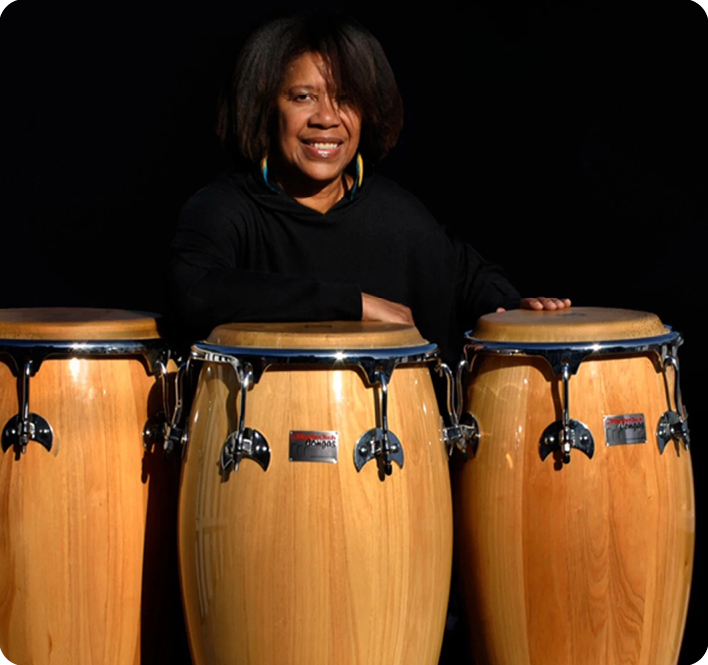
You have likely heard the artistry of Bobbye Hall without even realizing it. While her name might be a discovery for some, her distinctive percussion has graced the tracks of the world’s most beloved recording artists. A member of Local 47 (Los Angeles, CA), Hall established her reputation in Detroit’s legendary Motown scene and has since built a career spanning over five decades of landmark musical achievements. She shares her vast experience with a characteristic warmth and a hearty helping of good humor.

Even a small sample of artists she has collaborated with is extensive and remarkable: The Temptations, Marvin Gaye, Bill Withers, Bob Dylan, Carole King and James Taylor of Local 802 (New York City), Stevie Wonder of Local 5 (Detroit, MI), and Joni Mitchell of Local 47 are just the beginning. Hall’s rhythms—and her vibrant personality—have been a driving force behind dozens of Billboard Top 10 songs across soul, rock, and pop.

The list of percussion instruments Bobbye plays and records on is also impressive. When asked about her favorite, Hall says she doesn’t have one. “Because I am so inside of the music, and I love it all equally.”

Finding Her Rhythm

Hall’s career is all the more remarkable when you consider her unassuming beginnings. Growing up in Detroit, she first picked up a tambourine at church.

“Pretty quickly, I graduated to playing on pots and pans from the kitchen, hiding the best sounding ones under my bed,” she laughs. “My mom would ask, ‘Baby, have you seen this pot?’ I didn’t want her to cook in them because they had such a great sound. I was building my first drum kit.”

Recognizing her talent, her mother bought her a pair of bongos. “That was my first authentic instrument, and I really took off after that. I practiced in the bathroom because of the great acoustics. I was following a trail that was so obvious to me, and the neighbors were wonderfully supportive of my practice,” she says.

For Hall, the transition to a professional career felt like a natural progression. “It wasn’t a decision I consciously made,” she says. “It’s a gift. I stumbled into it, and I believe I was chosen for it. Music is my life, and my life is music. If it wasn’t for that, I would have had a very different life in Detroit.”

From the Kitchen to the Studio

While in high school, Hall performed at a Detroit club that featured a section for young musicians. “A couple of studio professionals heard me playing there, and asked if I’d like to play on a session. I said, ‘Sure, what’s a session?’” She began recording at Motown’s legendary headquarters, Hitsville USA (now the Motown Museum). Because she was only 13, the producers would pick her up from her home with her mother’s permission.

“The studio guys became my studio dads; since my father died when I was younger, they became my mentors. They raised me right. It was ‘Bobbye, we gotta go play,’ which was the right message I needed to hear as I was learning to do this. They were an all-male band known as The Funk Brothers. And I was the ‘Little Funk Sister,’” she says.

Hall notes that she felt welcomed and respected as an artist from the outset. “In the studio, it was simply about the music—you, me, and us. There was no focus on gender or genre; we were all there to create together.” Hall says she “never felt singled out or the only female session musicians in a male-dominated field and was never once treated like an outsider or made to feel like I didn’t fit in.”

When there were no sessions scheduled, Hall fondly remembers running around the studio with a young Stevie Wonder, a member of Local 5 (Detroit, MI). They played tag and jammed on whatever instruments they could find.

Shortly after starting sessions, Hall’s mother, recognizing her daughter’s drive, thought maybe she could benefit from some more formal music education. She took Hall to the Detroit Institute of Art.

“They evaluated me, and then basically told my mom to just let me play,” Hall says. “They said if they took me in as a student, they would have to rearrange what I was doing, and I was already doing it right. They didn’t want to change my natural style.”

Professionalism and the Union

At just 15, Hall joined Local 5, making her one of the youngest union members. For her, union membership was more than a milestone; it provided a vital sense of professional legitimacy and security. “I started in the studios at 13, making a few dollars—which was a lot of money to me back then,” Hall recalls. “On my 15th birthday, I was handed my union card, and that’s when I truly became a professional. I was so proud to be a young percussionist making my way.”

Beyond the title, the union offered a practical foundation for her career. “The union made a life in music a reality,” she says. “It provided structure and accountability. I didn’t have to negotiate for myself; the guaranteed scales were there whenever and wherever I worked.”

“In those days, I didn’t even know a life without being a union member,” Hall reflects. “I was the head of my household, traveling the world, and earning union scale for every session. I felt a real sense of responsibility.”

That sense of duty fueled an extraordinary work ethic. After moving to Los Angeles in 1970 and joining Local 47, Hall’s career reached new heights as she crossed over from the Detroit scene to the heart of the West Coast music industry. She became a first-call percussionist for icons like Carole King and Joni Mitchell, while also becoming a fixture on late-night television, performing on The Tonight Show with both Johnny Carson and Jay Leno. Her rhythmic touch graced nearly every major room in Hollywood, from Universal, Warner Brothers, and CBS, to Walt Disney, Columbia, Capitol, MGM, and Paramount.

In 1974, she performed at Carnegie Hall with James Taylor and Carly Simon, after appearing on two of his studio albums. Her old friend Stevie Wonder also called on her to contribute her beat to several songs. Tours with Bob Dylan followed, along with two albums of her own music. In 1979, she recorded The Wall with Pink Floyd, and also recorded with Bob Seger’s Silver Bullet Band in the early 1980s. Hall joined Stevie Nicks for her album Bella Donna and toured with Nicks in 1982 and again in 1986.

The wide breadth of unrelated genres underscores Hall’s underlying approach to session playing, regardless of who she is collaborating with. “Sessions are about adaptability,” she says. “Take Joni Mitchell, for example. My role was to use tools and knowledge to mimic an intuitive movement, a choreography, of what Joni was saying with her words.”

Inspiring the Next Generation

Her enduring passion for music remains her primary driver, and her love for making music is also something others can learn from. “I’ll take the money, sure,” she laughs. “But what I do is worth far more than the money. I’ve worn a great many caps, from household earner to running my own gig service with my equipment and opening a studio in my garage—but never stopped loving the music, and my spirit still goes and goes.”

Despite her massive success, Hall maintains a sense of wonder toward her journey. While she is a pioneer for many women and musicians of color, she prefers to let her work speak for itself. “I hope I can inspire others through what I’ve done,” she says. “I love what I do, and that is the real inspiration.

“I don’t really know what a role model is,” she counters. “But I hope I can maybe inspire through what I’ve done. It’s not really a deep thing. I love what I do, and that’s the inspiration.” To that end, Hall is planning to write a book to motivate emerging musicians and is interested in sharing her story in a TED Talk. “I’d love to just play a few things and show how I do what I do.”

Her advice to aspiring artists is to believe in their own potential. “If you want to do music, you have to dream that it’s doable. Play the instrument that speaks to you. If it picks you, that’s where the magic happens.” She also emphasizes the value of mentorship and connections within the industry. “In the music industry, that can also mean someone helping you to make a connection.”

“Once you find your path, it’s like the best drug in the world,” she says. “Music makes you a creator. I have had many angels who have helped me to create. But what you do in life, what you’re chosen for, once you clearly see that path, you say, yeah, I’m gonna take it. And then we just keep that vibe going.”


NEWS


https://totoabadi25.com/ abadicash abadislot Menara368 royalbola abadislot abadislot menara368 abadicash menara368 totoabadi Menara368