Now is the right time to become an American Federation of Musicians member. From ragtime to rap, from the early phonograph to today's digital recordings, the AFM has been there for its members. And now there are more benefits available to AFM members than ever before, including a multi-million dollar pension fund, excellent contract protection, instrument and travelers insurance, work referral programs and access to licensed booking agents to keep you working.

As an AFM member, you are part of a membership of more than 80,000 musicians. Experience has proven that collective activity on behalf of individuals with similar interests is the most effective way to achieve a goal. The AFM can negotiate agreements and administer contracts, procure valuable benefits and achieve legislative goals. A single musician has no such power.

The AFM has a proud history of managing change rather than being victimized by it. We find strength in adversity, and when the going gets tough, we get creative - all on your behalf.

Like the industry, the AFM is also changing and evolving, and its policies and programs will move in new directions dictated by its members. As a member, you will determine these directions through your interest and involvement. Your membership card will be your key to participation in governing your union, keeping it responsive to your needs and enabling it to serve you better. To become a member now, visit www.afm.org/join.

FIND OUT MORE ABOUT THE AFM


Home » Member Profiles » Leigh Pilzer


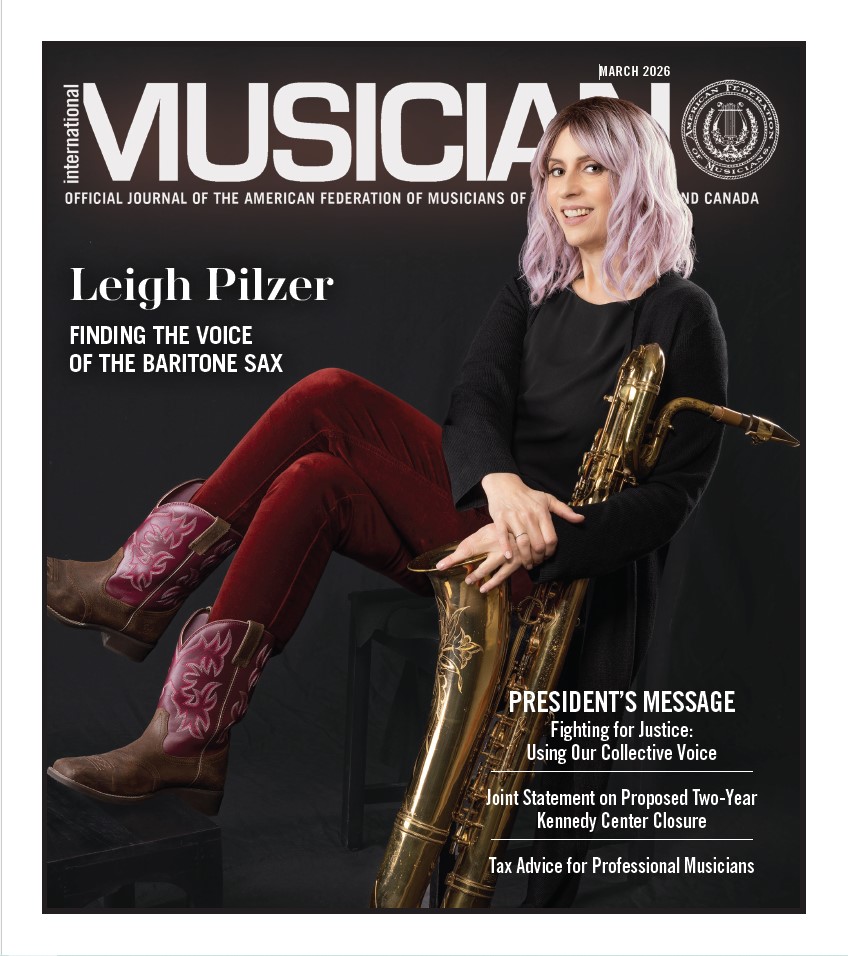
Leigh Pilzer

  -  

Sustaining the Swing Through Every Season

Back in 2020, saxophonist and arranger Leigh Pilzer—like pretty much every other musician in the country—was figuring out how to navigate the far-reaching implications of a pandemic on the music industry.

A DC native and longtime member of Local 161-710 (Washington, DC), Pilzer and a few colleagues had started exploring how to perform music together while socially distanced. Even then, she says, she relied on the assistance of the AFM to make things like that possible. She says she has continued to do that for most of her career.

“I joined the Federation as soon as I finished college,” she recalls. “My early gigs with the National Symphony, playing Capitol concerts and Memorial Day concerts, were extremely moving experiences. I would certainly not be doing any of this without union membership. When I think about it, many of my most memorable career highlights have been through the union.”

Finding the Voice of the Baritone Sax

Pilzer says she started on the cello as a kid, but that all changed in high school the first time she saw a big band. “I would go hear live music with friends after orchestra rehearsals,” she recalls. “One day I met Bill Potts, a writer/pianist/arranger at a local community college. He played some jazz music for me—and then he took me to hear Count Basie.”

As a cellist, she says, the logical choice of instrument to feed a growing hunger for jazz would have been the bass. “I wanted a clean start, though,” she says, “so I chose the saxophone.” Pilzer started on an alto. Not long after, she got called for a gig at the same community college. “The baritone sax player couldn’t make the date, so they handed me the bari. Immediately I knew it was the perfect fit.”

At Boston’s Berklee College of Music, Pilzer learned other skills that would later feature heavily in her professional life. Community college had given her a solid grounding in music theory and arranging, so she continued her studies in arranging at Berklee, where she tested out of the first two years of theory and advanced into upper-level arranging classes.

Pilzer graduated with a Bachelor of Music in Jazz Composition and Arranging from Berklee, followed by two master’s degrees from the University of Maryland in Jazz Studies and Saxophone Performance, and then a doctorate in jazz performance from George Mason University, where she was enrolled as a Presidential Scholar.

Performing and Arranging

Fast forward to today where, among her many other projects, Pilzer is a member of the Smithsonian Jazz Masterworks Orchestra and baritone sax player and arranger for the DIVA Jazz Orchestra. She has been a permanent member of DIVA since 2003. She says she is grateful to DIVA bandleader and drummer Sherrie Maricle of Locals 802 (New York City) and 16-248 (Newark/Paterson, NJ) for opportunities to create arrangements, and sometimes compositions, for the group. Her process, Pilzer says, has evolved somewhat over the years.

“My dad was a super early adopter of computers, back when there were punch cards,” she laughs. “I resisted for a long time because I was faster at writing music by hand. Once I started trying to write on the computer, I quickly realized that it was so much better for editing and generating individual parts. Electronic playback is also helpful to make sure I don’t miss any accidentals.”

Pilzer loves the joy she feels when she writes something and then hears it on playback, and it sounds exactly like what she heard in her head. That said, lot of jazz writers and arrangers she admires continue to write on piano and paper. “I’ve gone back to that. Somehow, the act of putting it down on paper settles it in my head,” she says.

Her work these days encompasses writing and arranging for a wide variety of groups in the DC area. “Most of my writing is for myself. After the pandemic, I got it in my head that I wanted to form a seven-piece band for the Washington Women in Jazz Festival that would comprise trumpet, alto sax, trombone, bari sax, piano, bass, and drums. There are so many fabulous women in jazz in this town.”

Pilzer produced a batch of charts, a couple of covers, but most of it is her original music. “That has turned into a library of 30-odd charts, mostly my own compositions, but also arrangements of some of the other bandmembers’ stuff.”

Jazz and Gender

She has some thoughts about playing in so-designated all-female groups. “If I put together a group of longtime friends and musical collaborators who happen to be women, the minute I do that, we are going to be labeled an all-female group. All-male groups don’t get labeled by their gender; they’re just groups.”

Pilzer says she was cognizant of this when working on her forthcoming album. “I thought I’d get similarly labeled. I’m really proud of the music, and I don’t want it to just get pigeonholed.” Accordingly, she says, half of the CD features the Washington Women in Jazz, and the other half is a mixed group. Pilzer’s getting ready to release a new recording with a mixed group featuring B3 and drums. “It’s a slamming, swinging album that I had so much fun with. I also brought in some guest brass, because who wants to listen to a baritone sax for 70 minutes?”

Much of the music she wrote for the seven-piece band was about her having had surgery and treatment for cancer in 2017. “I worked all through treatment,” she says. “I was on the road, and I was recording with DIVA. It was hard, but I did it. I was never public about it before, but I realized that by not being open about it, I was perpetuating that idea of cancer being something to hush up about.” She says it was a big decision to stand on stage and say it out loud. “But hey, spoiler alert: I’m still alive!”

Working with the Next Generation

When not performing or arranging, Pilzer fills the rest of her time with teaching. After a break of more than a decade, she is back at the University of Maryland teaching jazz theory and jazz arranging.

“I don’t teach sax because I don’t think I play it well enough to do that,” she laughs. “I stick to my passions, and I care passionately that people understand jazz. I focus a lot on tonal analysis of music from the Great American Songbook era. It’s important to understand how it evolved from the African and Western European harmonic structure into, say, bebop or modal jazz. I want students to have that foundation so that they’re writing their own music from a place of information.”

Likewise, she says, with arranging. “I teach students how to incorporate instruments efficiently and effectively. It’s crucial to send students out with tools that they can use in the real world. But I want them to walk before they can run, playing standards and learning the structure.”

Pilzer is fully aware of her role as a woman working in the jazz world. “I think it’s good for younger women and nonbinary students to see a woman who knows what she’s talking about in this genre—and also one who is not on the younger end of the spectrum.” She also firmly believes DIVA inspires young women audience members in a way that other bands can’t.

She hopes her students can benefit from her lived example. “Whoever you are, you can do this. But you’ve got to be professional, prepared, and show up—and bring a pencil,” she adds with a laugh.

Mentoring, Pilzer says, can take other forms. Sometimes it can mean raising awareness. “In January, I stopped by a booth at the Jazz Education Network conference and saw T-shirts with no women depicted on them. I pointed it out, and the next day they told me designs were on the way with women playing trumpet and bass. They are listening and hearing, and they get how important it is.”

And sometimes, she says, mentoring can mean she herself is on the receiving end of the lesson. Pilzer had the privilege of mentoring saxophonist Langston Hugues II of Local 802 (New York City) at Strathmore Music Center in Maryland.

“He was performing a concert of his own music, and some of it wasn’t what I was expecting. But he opened my mind as to what a composition for quartet or quintet could be,” she says. You’re never too old to learn lessons, including learning how music can be more flexible.

“Watching Hughes hear things I told him and then watching him go to Juilliard and practice the skills he needed for subbing on Broadway or Lincoln Center—it’s so uplifting. And also humbling. I see young musicians like him setting their sights on something and going for it, where I have sometimes been a little shyer or insecure about doing that. So, they also open my eyes to new ways of doing things,” says Pilzer.

Union Backing

While much has changed in the industry since the pandemic, Pilzer’s advocacy for the Federation has not changed—indeed, it has gotten stronger. “The jazz community and the AFM have not always agreed, historically, in terms of business models. The AFM knows this, and there is ongoing work at the union level to see how the AFM can work for all of us.”

The Music Performance Trust Fund (MPTF) is something Pilzer has been able to utilize to recent advantage in getting concerts scheduled and musicians hired. “I took part in a presentation at the University of Maryland, and I approached the Federation about MPTF funding to bring in my group. They very quickly agreed,” she says.

Pilzer, in turn, used the funding as an opportunity to get as much union representation as she could. “I felt great about helping the union back.” The MPTF is an important tool she believes can help further bridge gaps between the union and the jazz world.

Union backing also forms an important component of her role as a bandleader. “With a union contract, you have clear expectations about things like time and length of services, how much and when your musicians will get paid, pension contributions, and cartage,” she explains. “As a bandleader, I try to bring that same union clarity to my role and my expectations. I want them to know what they’re getting into.”

Those expectations, she says, obviously work both ways. “I never expect musicians to print their own music. That’s my job, and also mine to make the charts extremely clear and legible.”

She also doesn’t want to be that person who yells at people for making mistakes in rehearsals. “I want them to know that I respect them and understand that I’m much more interested in what they bring musically. I want it to be fun.” She also pays them as well as she can. “I hire professionals and treat them as such. Hopefully that reputation precedes me.”


NEWS


https://totoabadi25.com/ abadicash abadislot Menara368 royalbola abadislot abadislot menara368 abadicash menara368 totoabadi Menara368