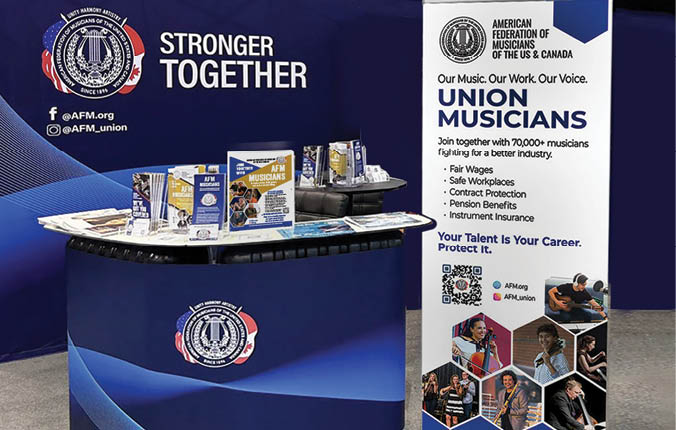
Now is the right time to become an American Federation of Musicians member. From ragtime to rap, from the early phonograph to today's digital recordings, the AFM has been there for its members. And now there are more benefits available to AFM members than ever before, including a multi-million dollar pension fund, excellent contract protection, instrument and travelers insurance, work referral programs and access to licensed booking agents to keep you working.
As an AFM member, you are part of a membership of more than 80,000 musicians. Experience has proven that collective activity on behalf of individuals with similar interests is the most effective way to achieve a goal. The AFM can negotiate agreements and administer contracts, procure valuable benefits and achieve legislative goals. A single musician has no such power.
The AFM has a proud history of managing change rather than being victimized by it. We find strength in adversity, and when the going gets tough, we get creative - all on your behalf.
Like the industry, the AFM is also changing and evolving, and its policies and programs will move in new directions dictated by its members. As a member, you will determine these directions through your interest and involvement. Your membership card will be your key to participation in governing your union, keeping it responsive to your needs and enabling it to serve you better. To become a member now, visit www.afm.org/join.
January 1, 2026
Wages Argott - AFM Director of Freelance Services and Membership Developmentby Wages Argott, AFM Director of Freelance Services and Membership Development
Local leaders ask me all the time for ideas about how to employ Freelance Co-funding for their membership. Freelance Co-funding program is defined in AFM Bylaws as “[a]n operating budget of $100,000 annually … allocated to a program whose sole purpose is to assist locals in developing and maintaining programs and services beneficial to freelance and club-date musicians not employed under a CBA.”
The best application of Freelance Co-funding really depends on your community of musicians, the health and size of your local, and tailoring an idea to have the most impact within that musical community. These guidelines are broad, but they illustrate the encompassing ideals for requesting co-funding:
As of this writing, 30 requests from 25 locals have been completed or are in process for over $85,000 in funding against budgets totaling almost $250,000—our previous high year was around $56,000. I’m thrilled to finally see the lion’s share of this allocation put to use. Here’s a brief overview of some of the 2025 requests:
Locals 99 (Portland, OR) and 161-710 (Washington, DC) addressed the need in their regions for a full-time organizer on their staff, for which Freelance Co-funding helped offset costs.
Locals 56 (Grand Rapids, MI), 65-699 (Houston, TX), and 94 (Tulsa, OK) identified communities of musicians in specific sectors of work as organizing targets and held social events, performances, and even educational training around these endeavors.
Locals employed performances as both member opportunities and organizing tools in Locals 30-73 (Twin Cities, MN), 553 (Saskatoon, SK), and 65-699.
Locals also made digital strides in providing performance opportunities for their musicians by enhancing their online referral and booking services for member musicians in Locals 40-543 (Baltimore, MD), 77 (Philadelphia, PA), and 190 (Winnipeg, MB). Local 380-443 (Twin Tiers, NY) took this role a step further by establishing a separate booking entity and promoting this service to member musicians across its large geographic jurisdiction.
Locals 105 (Spokane, WA), 279 (London, ON), and 293 (Hamilton, ON) invested in additional staff and material resources to better serve membership as well as aid in the promotion of the locals and their members. Locals 427-721 (Gulf Coast, FL), 518 (Kingston, ON), and 674 (Lewisburg, WV) provided practical training and professional development sessions for their members and musical communities.
Local 555 (San Juan, PR) debuted our transformative “Play Your Part” educational session for freelance musicians, utilizing co-funding for event costs and translation services.
Locals also reached new audiences directly: Local 1000 (Nongeographic) did so via exhibition in international conferences, and Local 542 (Flint, MI) through broadcasting a union internet radio station.
Locals 11-637 (Louisville, KY) and 67 (Honolulu, HI) provided opportunities closer to home by improving and making facilities available to musicians for practice, recording, and performance.
Co-funding requests must be made by local officers, so if you have an idea for an initiative, please reach out to your local leadership for more information. Officers may apply at AFMfreelance.org.