Now is the right time to become an American Federation of Musicians member. From ragtime to rap, from the early phonograph to today's digital recordings, the AFM has been there for its members. And now there are more benefits available to AFM members than ever before, including a multi-million dollar pension fund, excellent contract protection, instrument and travelers insurance, work referral programs and access to licensed booking agents to keep you working.
As an AFM member, you are part of a membership of more than 80,000 musicians. Experience has proven that collective activity on behalf of individuals with similar interests is the most effective way to achieve a goal. The AFM can negotiate agreements and administer contracts, procure valuable benefits and achieve legislative goals. A single musician has no such power.
The AFM has a proud history of managing change rather than being victimized by it. We find strength in adversity, and when the going gets tough, we get creative - all on your behalf.
Like the industry, the AFM is also changing and evolving, and its policies and programs will move in new directions dictated by its members. As a member, you will determine these directions through your interest and involvement. Your membership card will be your key to participation in governing your union, keeping it responsive to your needs and enabling it to serve you better. To become a member now, visit www.afm.org/join.
June 1, 2026
Ken Shirk - AFM International Secretary-TreasurerFederation officers generally come into their positions after having served for a good while as officers of their locals, and in the old days—the really old days—Federation officers’ columns in this paper seemed to be speaking more to local officers than to the general membership. As the baby boomers started taking office in the 1990s, however, the officers’ columns shifted noticeably toward the rank and file membership as their intended audience, and
I have endeavored to maintain that perspective in my own columns.
This month’s column is different—I am speaking directly to local officers and delegates who will be attending the 103rd AFM Convention later this month and deciding the future direction of this union, now 130 years old. I invite rank and file members to read along and perhaps engage their local officers and delegates in a discussion about the choices to make at this June’s convention.
Every decision made by the International Executive Board (IEB) has as its basis the following commitment, which affirms that if we are to have a union that effectively represents more than just symphonic and touring musicians, we must:
Organize to build power to enable members to attain fairness in the labor market and justice in the political realm by building membership in touring, freelance, recording, and local gig markets and developing power to achieve strong contracts.
When I joined this union, the AFM had 360,000 members. Today it’s around 60,000. It’s not because there are 300,000 fewer musicians in North America. They’re out there, just not with us. And why is that?
A smart member of my home Local 99 in Portland, Oregon, boiled it down to one simple, practical concept:
Musicians will join the union when they perceive that union membership will improve their economic bottom line.
Apparently, 300,000 musicians—most of them freelance/indie/general business players—concluded that union membership would not improve their income. Those of us who have spent time in this union know that’s an erroneous conclusion. But perception is everything. And perception must change if we’re to increase our strength. Refer back to the previously stated IEB’s guiding concept.
The International Executive Board has made two primary recommendations for the convention delegates’ vote, setting forth what we must do to find 300,000 musicians again. The first recommendation is to increase funding to the Federation via an increase in the per capita dues. Per capita dues are what each local pays the Federation each quarter based on a head count of each local’s membership. The IEB’s second recommendation is to set a realistic standard to which locals must adhere in order to approach effectively the job of representing musicians in their jurisdictions.
If we’re going to build power for better pay and a responsive government, we must engage in actual labor and community-based organizing, all across the Federation. For the last several decades, we’ve tried everything else besides organizing, and 300,000 musicians have shown us how well we did. It’s past time for us to do what every other successful union does: grow through organizing.
To that end, Recommendation No. 2 proposes that, as a baseline, every local must:
None of the above is particularly radical nor out of reach for any local, but the list does set forth in writing what any local that wants to be a recognized voice for musicians in its area should do. That these basic things should even need to be set forth in bylaws at all is an indicator of the philosophical gap between us and those 300,000 musicians.
Raises dues—per capita dues specifically. For regular members, the IEB’s proposal would increase dues by $20 per year (or $5/quarter or $1.67/month).
Federation per capita hasn’t been raised since 2013. Judicious administration by the previous Federation officers made that possible by keeping expenses—particularly staff expense—down. The accumulated surpluses since 2013 may leave some wondering why an increase is even requested.
Those 300,000 absent musicians is why.
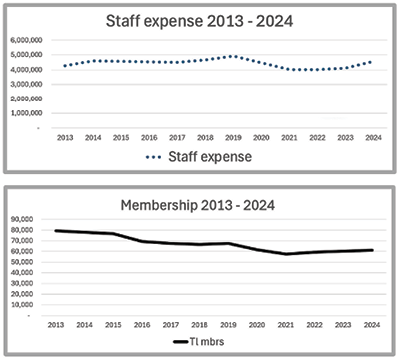
These two charts, covering the last 12 years, illustrate the relationship between economizing on staff and membership growth:

It’s a plain picture: investments in staff (the dotted line) remained relatively flat—which means staff was actually reduced after accounting for cost-of-living increases—and membership dropped by 20,000 in the same period (the solid line).
It takes people to make a union work.
The IEB’s commitment with Recommendation No. 1 is to:
There’s a piece in this recommendation for everyone, whether you’re a local officer or a local member.
Both these recommendations are about planning for the future, not reacting to the present. Reacting as we have for the last 130 years is a bad habit, particularly because it signifies not being in control of our destiny. Labor and community organizing is all about planning and taking action for the future, not doing damage control in the present.
Real organizing, however, requires people—organizers, supporting resources, lawyers, communications, and public relations—and all of that requires funding. Most AFM locals do not have the financial resources to deploy fully-functioning organizing programs in their areas. So, the IEB has determined to develop and deploy regionally-based multi-
local-coordinated organizing programs, initially in the five main regions of the US and Canada. They will work to the benefit of locals in each region—pooling and centralizing resources to achieve economies of scale.
That takes funding. At present, the Federation’s cash reserves are such that the IEB was able to initiate the program without new revenue. For 2026, the IEB plans to expend $1 million more than the projected income, all of it in support of organizing, and most of that for organizing staff salaries. That $1 million will repeat each year since it’s for ongoing salaries. But the staffing needs will increase as we get more active and engaged, so that $1 million deficit in 2026 will probably be $1.6 million in 2027 and over $2 million in 2028. That means by 2028, the Federation will have dipped into the reserves by almost $5 million without any new revenue. And make no mistake—organizing for any union is not an instant reward; it takes a lot of time and a lot of work.
The Federation can maintain that for a while, but not indefinitely—that’s where these two recommendations come into play. Ultimately, the 2026 Convention will be about choosing our future.
Delegates must be prepared to decide whether the status quo is satisfactory or whether together we take the first steps toward reimagining the AFM as something that 300,000 musicians will want to be a part of.