Now is the right time to become an American Federation of Musicians member. From ragtime to rap, from the early phonograph to today's digital recordings, the AFM has been there for its members. And now there are more benefits available to AFM members than ever before, including a multi-million dollar pension fund, excellent contract protection, instrument and travelers insurance, work referral programs and access to licensed booking agents to keep you working.
As an AFM member, you are part of a membership of more than 80,000 musicians. Experience has proven that collective activity on behalf of individuals with similar interests is the most effective way to achieve a goal. The AFM can negotiate agreements and administer contracts, procure valuable benefits and achieve legislative goals. A single musician has no such power.
The AFM has a proud history of managing change rather than being victimized by it. We find strength in adversity, and when the going gets tough, we get creative - all on your behalf.
Like the industry, the AFM is also changing and evolving, and its policies and programs will move in new directions dictated by its members. As a member, you will determine these directions through your interest and involvement. Your membership card will be your key to participation in governing your union, keeping it responsive to your needs and enabling it to serve you better. To become a member now, visit www.afm.org/join.
January 1, 2026
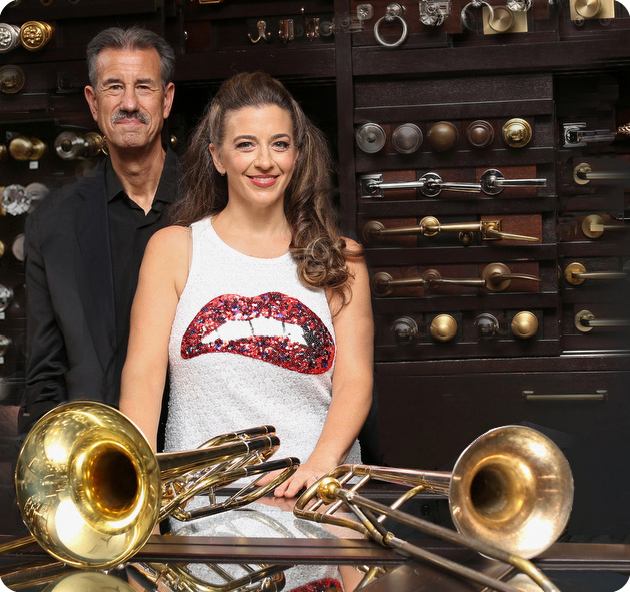
It can be tough being partnered with another musician. Respective schedules can make it hard to see each other and spend quality time. And when both partners play the same instrument, that adds another level. The International Musician sat down with married trombone players Jennifer Wharton and John Fedchock, both of Local 802 (New York City), to find out how they make their relationship work, and how they overcome current challenges facing their very different careers in the music industry.
Although she got her start classically, Wharton has roots in jazz, commercial, and Broadway music, having held bass trombone chairs with several hit musicals including Sweeney Todd, West Side Story, and Porgy and Bess. She currently performs in the pit for The Great Gatsby, and has won the Radio City Christmas Spectacular bass trombone chair six times.
An active studio musician, Wharton can be heard on well-known streaming TV shows and has performed and toured extensively with groups ranging from NOVUS music ensemble to Darcy James Argue’s Secret Society.
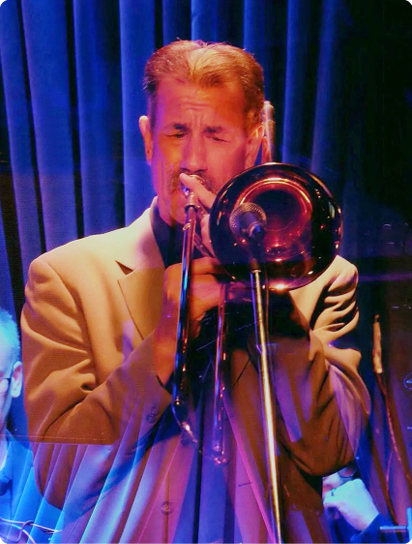
Fedchock’s multifaceted career spans four decades, getting his start with the Woody Herman Orchestra and later establishing himself in the New York jazz scene as a formidable trombone soloist, bandleader, and arranger. His commitment to the craft is undeniable, having released many influential albums throughout his career. With his critically acclaimed group, the John Fedchock New York Big Band, his name has appeared in the Downbeat Readers Poll under the trombone, arranger, and big band categories, simultaneously, for several consecutive years. Fedchock is also a two-time Grammy Award nominee for Best Instrumental Arrangement.
International Musician: Dealing with a spouse or partner who plays the same instrument is a good place to start. How do you keep from killing each other, to put it plainly?
Fedchock: We rarely talk about music at home. And we especially don’t talk about the trombone.
Wharton: I realized pretty quickly in our relationship that, if we were going to stay together, we needed that separation, unless we need to borrow equipment from each other. We even practice on different floors of the house. I approach our relationship exactly like it was when we met. John was traveling and doing his own thing, and that’s the guy I married. He has a free pass to live his life.
Fedchock: What she bought into was “as advertised.”
Wharton: It’s a lot of comparing schedules. When we got serious, we made a shared calendar so we could see what was going on with both of us. The hardest part is managing looking after our dog.
IM: How did you meet? I assume playing the same instrument in the same town made it inevitable that you would eventually cross paths?
Wharton: Someone we knew was basically trying to set us up. I was thinking it was to get work, but John asked me out a few weeks later. So, it wound up being a different kind of gig.
Fedchock: It was an easy fit and we complement each other well. I’m low key and Jen is more out front with stuff, but she’s very sweet, even though she typically won’t let anyone know that. We’re certainly never bored with each other.
Wharton: Plus, he’s tall.
IM: You both followed quite different paths to being working professional trombonists. And it should also be noted that you technically don’t play the same instrument, since Jen plays bass trombone.
Wharton: I grew up in Pittsburg, California. I wanted to play sax in school, but I couldn’t copy my sister. I ended up on the bass trombone by default because I missed audition day, but then I fell in love with it. The music teachers in my school were incredible and made me want to be part of what they were doing.
Still, I didn’t think I was good enough to major in music and was going to study marine biology. I couldn’t afford to go to a four-year college, though, so I ended up at a junior college with a really good music program. Music was the hardest thing I could imagine doing, so I did it. My family was against it, but they now realize the error of their ways. I transferred to the New England Conservatory to finish my degree, and during the pandemic I got a master’s from New Jersey City University.
Fedchock: I’m from just outside of Cleveland. In 4th grade, I saw a demo of instruments. I thought the trombone looked strange, and it intrigued me. Also, I was an introvert, and the social component of music was a big draw. And then I realized I had an aptitude for it, especially after I got involved in jazz. I wound up getting degrees in music ed and jazz studies at Ohio State, and my master’s in jazz studies and contemporary media at Eastman School of Music.
IM: Fast forward to today, as working professionals, where you both work in very different aspects of the same industry.
Fedchock: The traveling stuff keeps things varied for me. Jen primarily works in New York City, and she mostly has a similar schedule from week to week.
Wharton: Broadway work has some elements of an office culture, for lack of a better expression, because we’re on top of each other all day, every day. John doesn’t get much of that office politics thing because he typically travels as a soloist.
Fedchock: The hardest thing as a freelancer is that you never get to turn it off. You’re always a musician. There’s never a true release or a vacation. We went to Hawaii and we both brought our instruments.
IM: Jen, I’m guessing that forming your own group in 2017, Bonegasm, has given you more insight into the freelance world. What was the reason behind the group?
Wharton: I was seeing younger people moving to New York City and improvising on bass trombone. I didn’t think I’d ever get to do that. At the same time, I always wanted to have a trombone quartet, so it was kind of organic. John did some arrangements for us, and it was a blueprint for something that could really make me happy. It’s basically a big band, my happy place, but without trumpets and saxes. Also, it’s a way for me to force composers to deal with the trombone as a melodic instrument, rather than background.
Fedchock: The idea was to stretch the instrument. Besides me, Jen has commissioned over three dozen composers to write for the group. The trombone plays the leading role, rather than secondary—melody, harmony, rhythm, all of it. Our albums demonstrate that four trombones can really do anything.
Wharton: My time commitment with Bonegasm ebbs and flows based on my bandwidth, teaching commitments, etc. I have a bunch of tunes we haven’t recorded yet, and a few things on the books for 2026. I have also learned that I’m good at getting grants, of which I’ve gotten several for Bonegasm events and tours. We’ve been lucky to play in some big venues and well-known places. It takes a ton of time, but it has definitely given me an enormous appreciation for how John generates his own work. As a freelancer, I was always just waiting for the phone to ring.
Fedchock: Having your own band is like playing an instrument. If you don’t pay attention to it every day, it will wither.
IM: Teaching is important to both of you. Why is that?
Wharton: My dad was a teacher. At his memorial, his students talked about how he had changed their lives. It’s exactly how I felt about all my music teachers. Teaching is my way to pay tribute to him and carry on that idea. Teaching is not easy. It’s exhausting. Last year, I taught full time at Penn State, and all my downtime was spent doing lesson planning. I feel like I’m still recovering from that. Every ounce of your creative juice goes to someone else, and sometimes they don’t give it back. But sometimes you’re also the only adult in their lives that believes in them.
Fedchock: I first got excited about music in school band. Being a band director was my plan. As I got better as a player, I realized being a performer was an available avenue, but I utilize everything I learned in my education degree every day, even with my own band. I formerly taught at Purchase College and Temple University. These days, I do a lot of clinics. If you treat young students like professionals, they rise to the occasion.
Wharton: I was a late bloomer. When I got to high school, I quit playing. When I started again, I was so far behind. I asked a teacher how he knew I had potential, and he told me he just treats everyone as if they do. That is profound, and it applies whether students are performing in an orchestra or in a big band. You’re fostering a love of what they do. If you have that love and the curiosity, it’s something you can keep doing for the rest of your life.
IM: Jen, female bass trombonists are not exactly common. Do you see yourself as a role model at all, in both performance and education?
For sure, for a variety of reasons. First, I can be a resource for anyone coming into the industry. Second, I can be an example—of what to do, and what not to do. Third, I can be a champion, someone who recommends things based on my own experiences. After the pandemic, contractors started becoming more aware of some of their blind spots in hiring, including women. I was able to suggest new people they didn’t know.
When I first came to New York, there were very few women doing what I was doing. The way I was treated in the early days made me think that was the just price I had to pay for being female in this business. But now I’m just one of many women in the city doing this. That said, it is a continual slog. But I live loudly, so I’m hard to ignore. And that makes me a good resource.
IM: Speaking of education, you’re both attending the Jazz Education Network conference in New Orleans this month. What’s that about, and why is it important?
Fedchock: Freelancers have a saying: if you’re not appearing, you’re disappearing. So, part of our attendance is visibility. The conference is mostly about education and clinics, with plenty of opportunities to interact with people and keep you in their mind so they know you’re out there.
Wharton: It’s a lot of networking with other educators. We will also drop by the AFM booth. It’s important to have the Federation present, because in the jazz world, students don’t usually know anything about the union.
IM: Why is union membership so important to both of you?
Fedchock: When I moved to New York City, I also played Broadway shows like Jen, before I moved more toward commercial work. As a young musician, having that union backing was really important to me. Nowadays, Local 802 has been fantastic about combining our contributions to get joint health care. Also, there are certain types of work you can’t do in New York unless you’re in the union. So really, you’re discounting your career if you’re not an AFM member, losing opportunities for good income with serious musicians.
Wharton: For me, the best example of the power of union is the recent Broadway negotiations. There was a lot that show producers wanted to take away from us, and we almost went on strike. Ultimately, we are the only people who can look out for us. So much of the industry is trying to get rid of live music, so we need group efforts through the union to keep the work and protections.